St. Teresa Margaret of the Sacred Heart, Extended Biography
Extended Biography - St. Teresa Margaret of the Sacred Hearts
Her Early Life
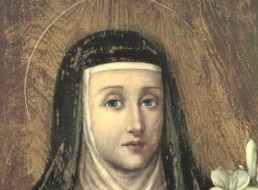
St. Teresa Margaret was born Anna Maria Redi on July 15, 1747 to a large, loving Catholic family in Arezzo, Italy. She was baptized the following day, the Feast of Our Lady of Mount Carmel by V.R. Canon John Baptist, the brother of her father. Her Godfather was Cardinal Henry Enriquez. She was a beautiful child with clear blue eyes, golden hair and delicate features which might have caused one anticipate for her a future as the lady of a manor and a life of leisure.
Her father Ignatius and her mother Camille were of the lower Tuscan nobility but were not overly wealthy. Anna Maria was the second of thirteen children. Her mother bore twelve children in fourteen years. The last two were twins who lived only a few weeks. Three other children also died in infancy. After a gap of six years the last child, Teresa was born. This child was given Anna Maria’s name in Carmel. Anna Maria (St. Teresa Margaret) had died six years before little Teresa’s birth.
Camille did not have a strong constitution and the strain of childbirth left her a semi-invalid. As the oldest girl, Anna Maria was entrusted with the supervision of the older of her little siblings while her mother was busy in the nursery. Her father said of Anna Maria that she had a fiery temperament and she was not above getting physical to maintain control over her little charges.
Her father testified that he could clearly see that from the age of five, Anna Maria had given her heart completely to God and she used all her facilities to know and to love Him. In later years she told her confessor simply that “from infancy I have never longed for anything other than to become a saint.”
“Who is God?” she asked her mother, her father, her aunt… The answers she received from the adults around her never fully satisfied her. People told her about God, what God is, not who God is. When her mother told her one day that God is love, Anna Maria lit up with joy. This answer at last gave her some satisfaction. But then she wondered, “What can I do to please Him?” From this moment her inexhaustible quest to love God as He loved her had begun. It is touching to note that when this childhood zeal was brought up to her, she replied in innocence “But everyone does that”.
Anna Maria’s parents were serious and pious. The family circle was warm and loving. Family prayer and daily Mass were an integral part of their lives. It appears that Camilla would have liked more social life in the villa but Ignatius would have seen that as a waste of resources and time.
The Redi villa was an ideal home for a child with a religious disposition and it is probably not an accident that all but one of the eight surviving children entered religious life or the priesthood. The large comfortable house had inspiring murals of the crusades on the walls of the entrance hall. The bedrooms contained religious art. A striking fresco of the Assumption was on the ceiling of Camilla’s room. Anna Maria’s bedroom had its own altar where she spent hours in prayer, after bribing the young ones with holy cards if they would leave her in peace. Sometimes they would creep back to observe her absorbed in prayer. Her brother Cecchino recorded that he thought she looked like a little Madonna.
The villa contained beautiful gardens and orchards. Anna Maria could be found in the corner of the gardens looking toward heaven and “thinking”. Close to the house was a chapel. It was decorated simply with frescos from episodes in the life St. Francis of Assisi. Anna Maria took St. Francis as her patron and was inspired by him with a love of poverty.
Although it was a peaceful and prosperous home, the children were not permitted to be idle. They were expected to spend their leisure time constructively. Anna Maria learned sewing and knitting and she was sometimes found knitting a simple object while completely absorbed in prayer.
At the age of seven Anna Maria made her first Confession. At that time first Confession preceded first Communion by several years. She was very attracted to the sacrament and prepared for it carefully and received it often. A conversation which took place while returning from Church and recorded by her father gives an idea of her attitude towards the sacrament.
“I have been thinking about the text that was preached on Sunday, the unforgiving servant. We come to the great King of Heaven with empty hands, in debt to Him for everything: life itself, and grace, and all the gifts He lavishes on us. Yet all we can say is, ‘Have patience with me, and I will pay thee all I owe,’ while all the time we could never pay anything towards the remission of our own debts, if God did not put into our hands the means to do so. And then, how often do we go away and refuse pardon for some slight fault in our neighbors, withholding our love, remaining aloof, or even nursing a grievance against them, and building up grudges that cool charity.”
After this conversation, Ignatius, who already appreciated the piety of this child, felt certain that God was calling Anna Maria in a special way. From that point on he began to provide her with true spiritual direction appropriate to her understanding. It was Ignatius who introduced Anna Maria to the devotion to the Sacred Heart, a devotion which became one of the central focuses of her spiritual life. The love of this father and daughter grew deeper as their profound spiritual confidences expanded the already deep familial affection. As an adult, Sr. Teresa Margaret would say “So great was the good my father has done to my soul that I can truly claim that he has been my father twice over”. It is a tender irony that in aiding the rapid spiritual growth of this most beloved daughter Ignatius was preparing the path that would take her away from him forever.
St. Apollonia’s Boarding School
At the age of nine, Anna Maria was sent to the boarding school of the Benedictine nuns of St. Apollonia’s in Florence. While other families of their status thought educating their daughters was a waste of money, the Redi family was determined to do so. His decision to provide the best of educations for Anna Maria and her three sisters as well as for his four sons forced Ignatius to tighten the family budget. One of their sacrifices was to give up the family coach. This was not only a sacrifice in convenience but also in status. A coach was a mark of a family’s situation but Ignatius was not moved by such considerations. Young Anna Maria was deeply impressed by this sacrifice and urged her older brother to be very diligent in his studies in response to this generosity.
St. Apollonia’s boarding school, being Benedictine, was simple, austere and unadorned. It was quite a change from the lush sun-drenched Redi villa. But Anna Maria had wanted to attend St. Apollonia’s because she heard that one could better serve God there.
The daily life of the school was likewise simple and austere following in many ways that of the nuns themselves. Each pupil had her own room, the day was regulated by the sound of a bell, and meals were taken in silence or with the reading aloud from a good book. The course of studies was more in the line of a finishing school rather than one of rigorous academics. Even so, Anna Maria had some difficulty with her studies, especially Latin and mathematics and it was only with regard to her studies that she was ever found lacking. She was scolded for being lazy although she did apply herself to the work. Otherwise the nuns considered her modest, cheerful and obedient and it was clear that Anna Maria was very happy at the school.
She passed her years at school appearing little different from her classmates. Yet Anna Maria was already working on a method of perfection which was to last all her life and take her to the heights of sanctity.
Aside from the noise of her younger brothers and sisters, it was easy enough at home to slip away unnoticed and spend hours in prayer and meditation to which she was called at a very early age. At home she could spend time with her holy cards or alone and in thought in the corner of the garden. She could pursue her program of holiness without arousing the curiosity of those around her. The environment at school was quite different. It would be difficult to continue her practices without calling attention to herself yet she was determined to continue her spiritual progress while not appearing to be different from any other student.
At the age of ten, Anna Maria was developing a well-balanced program for her spiritual life. She saw the necessity of exterior conformity to all the directions of her teachers and the practices of her classmates all the while striving quietly for sanctity. Her method was to hide herself. She would shun anything which would appear singular or attract attention. She would appear no different than any other student, or better yet, she would pass unnoticed while her interior life flourished.
There were two reasons Anna Maria wanted to keep her interior life hidden. First, she understood from an early age that “the merits of a good action can diminish when exposed to the eyes of others who, by their praise or approval, give us satisfaction or at least flatter our self-love and pride too much; and that therefore it is necessary to be content to have God alone.” The second reason was in order to imitate the hidden life of the Holy Family. This singular family appeared to the folk of the little village of Nazareth to be no different from any other. This was Anna Maria’s goal.
But she needed help in carrying out her program especially after making her First Communion. The nuns allowed her to make her First Communion on the Feast of the Assumption, one month after her tenth birthday and a year earlier than usual. Though she tried to hide her piety, the nuns had noticed her devout and recollected attitude in prayer. They noticed her joy in the presence of the Tabernacle and the deep sighs which escaped while she gazed upon it. Sometimes tears betrayed her emotions as the older children went to receive the Blessed Sacrament. And so the good sisters moved up the date for her First Communion.
From that day she continually experienced movements of love which impelled her to try to live a more holy life. Yet she feared others would notice if she intensified her devotional exercises and this went against her determination to remain hidden. She did not want to turn to the regular confessor of the school for advice for the same reasons. Any extended time in the confessional would arouse curiosity. In her need, she turned to the one she called twice her father; and so started an extraordinary correspondence with Ignatius Redi. He remained her spiritual director for the next five years until, as the result of a retreat, she came under the direction of Dom Peter Pellegrini. It is a great loss for us that Ignatius, obedient to her wishes, burned each of Anna Maria’s letters after reading it.
Dom Pellegrini had great confidence in Anna Maria’s piety, disposition for the religious life and love of God. He immediately endeavored to help her “to soar in the way of God”. He gave her good reading material and helped her to make rapid progress in mental prayer and the virtues.
It is a mark of Anna Maria’s intelligence that she succeeded in her almost contradictory goals, extraordinary growth in holiness while appearing to be just like all the rest. The proof of her success can be found on the one hand, in the permission her confessor gave her to receive Communion as often as the nuns, and on the other, by the general opinion of her held by her classmates and most teachers that she was a good, but more or less ordinary girl.
At the age of sixteen as her time at St. Apollonia was coming to an end, Anna Maria was finding it difficult to make a decision regarding her future. She felt drawn to the religious life and loved the Benedictine nuns at St. Apollonia yet there was something missing. A very strange and singular incident put Anna Maria on the path to Carmel.
One day a distant acquaintance of Anna Maria, Cecilia Albergotti, who was about to enter Carmel, paid a farewell visit to St. Apollonia. She told Anna Maria she wished to speak to her but the time passed and there was no opportunity to do so. However, as she was leaving Cecilia took Anna Maria’s hand and looked at her intently, saying nothing. Anna Maria walked back to her room with a strange feeling inside. Suddenly she heard the words “I am Teresa of Jesus, and I want you among my daughters.” Confused and a bit frightened, she went to the chapel and knelt before the Blessed Sacrament. She heard the words again.
Now convinced of the authenticity of the locution, she determined at that moment to enter Carmel and started immediately making plans to leave the school. She was only home for a few months when preparations were made for her application to the Carmel in Florence. She entered on September 1, 1764 a few weeks after her seventeenth birthday taking the name Teresa Margaret of the Heart of Jesus.
Entrance into Carmel
The community she entered contained thirteen professed nuns and two novices. The religious observance in the convent was excellent and Teresa Margaret always had high regard for the nuns there whom she called angels or great saints. She always, to her last day, felt unworthy to be among them.
From her first days in Carmel it was obvious to her superiors that she was an unusually mature and capable young woman. Because of her spiritual maturity she was treated severely by the novice mistress, Mother Teresa Maria, for the purposes of aiding her growth. Although Teresa Margaret exercised complete control over her actions and attitudes, her fair complexion which blushed bright red often gave away the interior battle she waged to maintain this control.
The period of postulancy was usually three months but it was extended one month because she developed an abscess on her knee. The ailment required surgery to scrape the infection away from the bone. This was done without anesthesia and the nuns marveled at her courage. Teresa Margaret however chided herself when a small whimper escaped her during the cutting. She feared that this ailment might cause the nuns not to accept her into the novitiate but there was no cause to worry. The nuns had found her spiritually mature, obedient, with a sweet and gentle nature. They considered her a gift and a true daughter of St. Teresa. She was accepted by a unanimous vote.
It was the custom at the time for the candidate to make a brief return to the world to consider once more the life she was leaving behind. Teresa Margaret visited again with members of her family and spent precious time with her father. There was no doubt now that their next parting would be forever. If anything could have kept Teresa Margaret from retuning to the Carmel, it would have been the pain she was causing her father. When Ignatius brought her back to the convent those around her were alarmed at her pallor. That evening she confided in her superior, Mother Anna Maria “I do not think that it is possible for me ever to suffer greater pain than that which I experienced in leaving my father.” She wept copious tears that night to the point of alarming Mother Anna Maria and causing her to wonder how Teresa Margaret had kept her composure through the day.
The next day Teresa Margaret was composed and radiant. Her father however was overcome and moved to a back corner of the church unable to watch the clothing ceremony. Later in the afternoon he was able to visit with her in the parlor. He could see her flooded with the peace the world cannot give and a joy no earthly pleasure can produce. He left her with an emptiness his other children could never fill yet he was at peace and thankful to God for the gift of this sacrifice.
The duties of the novices were general housekeeping and various small tasks needed by the community. But even as a novice, Teresa Margaret started the work that would take most of her time and energy for the rest of her years in Carmel; that of caring for the sick. Of the thirteen professed nuns, nine were elderly and often ill. Teresa Margaret started by assisting the aged novice mistress prepare for bed each night. She then took on the care of an ailing novice. More and more she spent any free time assisting the infirmarian in caring for one or the other of the seriously ill nuns. Some times she would move into the room of a sick sister to provide care during the night. Aside from the required periods of prayer Teresa Margaret gave her self to physical labor. Her work went far beyond what was required or expected.
A year after her clothing Teresa Margaret was scheduled to be professed. The abscess on her knee reappeared. She wondered if this might be a sign that she was mistaken, that she did not have a vocation after all. She brought her doubts before God with simplicity and humility desiring only the will of God whatever it might be. The abscess disappeared. When the time came for her profession, with honest feelings of unworthiness she asked to be professed as a simple lay Sister. This was not allowed but she kept this humble attitude all through her life in Carmel and often helped the lay sisters at their tasks. No duty was too lowly for her.
Teresa Margaret lived only four years after her Profession. For two years she served as assistant sacristan but never gave up her work among the sick. She was finally named assistant infirmarian though she had been doing the job all along.
She loved this job and the constant charity it demanded for she stated “love of neighbor consists in service.” Although “assistant” she soon was in fact exercising full responsibility for the infirmary. She was young and strong and seemed to thrive on the hard work. During her years of service, in spite of her continued determination to keep hidden her gifts and graces, remarkable incidences occurred: the miraculous healing which occurred after Teresa Margaret, filled with compassion, kissed a sister weeping in pain; her ability to converse with a deaf nun with whom no one else could communicate; various cures which, though not miraculous were at the least unusual; and her uncanny ability to know when a patient needed her no matter where in the monastery she might be.
Her Interior Life
Teresa Margaret had a rich, active interior life. The first tenant, as has been mentioned, was to remain hidden, to keep her gifts and graces hidden from all but her Lord while appearing quite ordinary to the world.
In her desire to prove her love to God, she practiced severe penances; sleeping on the floor, using a hairshirt, leaving windows open in the winter and closed in the summer, taking the discipline, etc. There was nothing masochistic in these practices. She wanted to discipline her body and unite herself to the suffering Christ. For her, suffering was a way of repaying love for love. As she grew she modified these practices and took as her motto “Always receive with equal contentment from God’s hand either consolations or sufferings, peace or distress, health or illness. Ask nothing, refuse nothing, but always be ready to do and to suffer anything that comes from His Providence.”
Her daily spiritual exercises were simple. She determined to present a smiling and serene exterior no matter how severe her interior and exterior trials. She practiced the art of never doing her own will for she believed that “she who does not know how to conform her will to that of others will never be perfect.” She would never offer an excuse for a fault or defend herself when falsely accused. She wrote that “everything can be reduced to interior movements, where the constant exercise of abnegation is essential.” She believed that God would be found when God alone is sought. To that end she made the following resolution: “I propose to have no other purpose in all my activities, either interior or exterior, than the motive of love alone, by constantly asking myself: Now what am I doing in this action? Do I love God?’ If I should notice any obstacle to pure love, I shall take myself in hand and recall that I must seek to return my love for His love.” As for love of neighbor, she determined to “sympathize with their troubles, excuse their faults, always speak well of them, and never willing fail in charity in thought, word or deed”.
All these little practices seem to be no more than what any good Christian should be doing. How simple and un-heroic they are. Yet to spend even one day in the minute by minute application of them would be more than most could hope to accomplish.
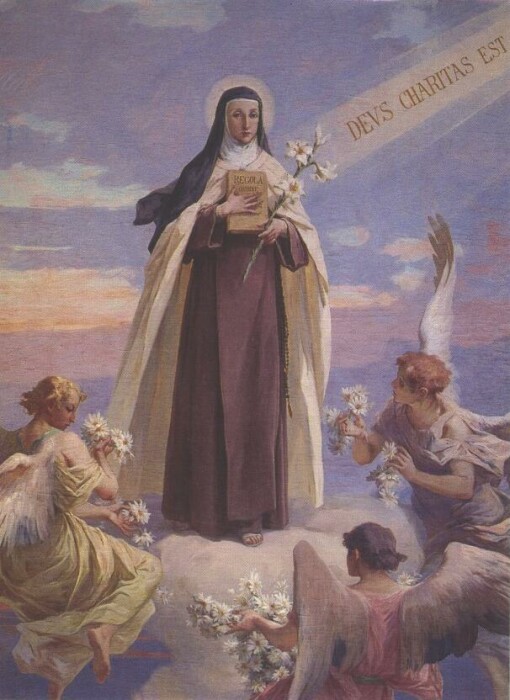
One Sunday in choir, Teresa Margaret was given a particular grace to understand the deep meaning of the love of God. While the community was reciting Terce, the words “Deus caritus est” (God is Love, I John 4:8) were read and it seemed to her she heard them for the first time. She was flooded with an elevated understanding of these words that seemed to be a new revelation. Despite the fact that she tried carefully to hide this sudden grace, all around her were aware something out of the ordinary had happened. These words occasioned a mystical experience which transformed her knowledge of God.
For the next few days the words “God Is Love” were constantly on her lips as she went about her duties. She appeared so out of herself that the Carmelite Provincial was brought in to examine her to see if she were suffering from “melancholy”. After examining her he responded: “I would indeed very happily see every sister in this community afflicted with such ‘melancholy’ as that of Sister Teresa Margaret!” It was only later that the community came to attribute her “faraway look” to her habitual awareness of the presence of God and His continual operations in her.
Night of the Spirit
This grace was however to start a great spiritual trial for Teresa Margaret. She had always found it impossible to return to God “love for love” as she desired. Now that she had a mystical experience of the love of God the abyss between God’s love for her and her ability to return that love sufficiently became a source of increasing torment to her.
In a series of letters to her spiritual director Fr. Ildephonse she wrote: “I am telling you in strict confidence, sure of your discretion that I find myself in pain because I am not doing anything to correspond to the demands of love. I feel that I am continually being reproached by my Sovereign Good and yet, I am very sensitive to the slightest movement contrary to the love and knowledge of Him. I do not see, I do not feel, I do not understand anything interiorly or exteriorly which could impel me to love … no one can imagine how terrible it is to live without any love when one is actually burning with the desire for it.”
“This is a torture to me, let alone the fact that it requires such an effort to apply myself to the things of God,” she confessed later. “I fear that God is very displeased with my Communions; it seems that I have no desire to ask His help because of the great coldness which I experience … It is the same with prayer and, of course, in all the other spiritual exercises. I am continually making good resolutions but I never succeed in attaining some way of successfully overcoming these obstacles which stand in my way and prevent me from throwing myself at His feet.”
“The tempest has become extremely violent and I feel myself being so knocked about that I scarcely know what to do if this continues. Everywhere there is darkness and danger. My soul is so dark that the very things which used to afford me some spiritual consolation are only a source of torture to me … I must do violence to myself in order to perform each interior and exterior spiritual exercise … Finding myself in this state of supreme weariness I commit many failings at each step … My mind is in such turmoil that it is open to temptations of every sort, especially to those of despair … I have a great fear of offending God grievously … I see that I do wrong and at the same time try to follow the inspiration to do good and then I feel remorse for my infidelity; and to top it all, I am not succeeding in conquering myself because my repugnance is so great …”
“The cruelest torturer of her soul,” wrote Fr. Ildephonse, “was her love which, in the very same measure that it increased – hid itself from the eyes of her spirit. She loved, yet believed she did not; in the measure love grew in her soul, in the same measure augmented the desire of loving and the pain of thinking that she did not love.” He was convinced that she was at the stage of Spiritual Marriage. When he later heard of her sudden and unexpected death he remarked “she could not have lived very much longer so great was the strength of the love of God in her.”
Her Death
It is suspected that Teresa Margaret had a premonition of her death. After obtaining permission from Fr. Ildephonse, she made a pack with Sr. Adelaide, an elderly nun she was caring for. The pact was that when she died, Sr. Adelaide would ask God “to permit Sister Teresa Margaret to join her quickly in order that she may love Him without hindrance for all eternity and be fully united with the fount of divine charity.” Shortly after the death of Sr. Adelaide, Teresa Margaret was indeed with God. It is likely that the cause of Teresa Margaret’s death was a strangulated hernia. It is probable that it was in lifting the heavy, inert body of Sister Adelaide that she strained herself causing the hernia. If so, it was a delightful seal to their pact.
In mid-February, 1770, Teresa Margaret wrote her last letter to her father, in which she begged that he begin a novena to the Sacred Heart at once for a most pressing intention of hers.
On March 4th she asked Father Ildefonse to allow her to make a general confession, as though it were to be the last of her life, and to receive Communion the following morning in the same dispositions. Whether or not she had any presentiment that this was indeed to be her Viaticum one cannot know; but in fact it was. She was only twenty-two years old and in excellent health, yet it appears she was making preparations for her death.
On the evening of March 6th Teresa Margaret arrived late to dinner from her work in the infirmary. She ate the light Lenten meal alone. As she was returning to her room, she collapsed from violent abdominal spasms. She was put to bed and the doctor was called. He diagnosed a bout of colic, painful but not serious. Teresa Margaret did not sleep at all during the night, and she tried to lie still so as not to disturb those in the adjoining cells. The following morning she seemed to have taken a slight turn for the better.
But when the doctor returned he recognized that her internal organs were paralyzed and ordered a surgeon for a bleeding. Her foot was cut and a bit of congealed blood oozed out. The doctor was alarmed and recommended that she should receive the Last Sacraments right away. The infirmarian however, felt that this was not necessary, and was reluctant to send for a priest because of the patient’s continued vomiting. In addition, Sister Teresa Margaret’s pain appeared to have lessened. The priest was not called.
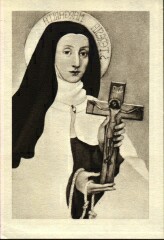
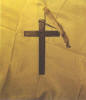
Teresa Margaret offered no comment, nor did she ask for the Last Sacraments. She seemed to have had a premonition of this when making her last Communion “as Viaticum”. She held her crucifix in her hands, from time to time pressing her lips to the five wounds, and invoking the names of Jesus and Mary, otherwise she continued to pray and suffer, as always, in silence.
By 3 p.m. her strength was almost exhausted, and her face had assumed an alarmingly livid hue. Finally a priest was called. He had time only to anoint her before she took her flight to God. She remained silent and uncomplaining to the end, with her crucifix pressed to her lips and her head slightly turned towards the Blessed Sacrament. The community was stunned. Less than twenty-four hours earlier she had been full of life and smiling serenely as she went about her usual duties.
Glory Revealed
Teresa Margaret had attempted all her life to remain hidden. In many ways she succeeded. But upon her death, the veil over her exalted sanctity was lifted by God Himself.
The condition of Teresa Margaret’s body was such that the nuns feared it would decay before proper funeral rites could be accomplished. Her face was discolored, her extremities were black, the body already bloated and stiff. When her body was prepared and laid out in the choir later in the day, it was almost unrecognizable to the sisters who had lived with her for the last five years.
Her funeral was held the following day and plans were made for her immediate burial. When she was moved into the vault however, everyone noticed that a change had taken place in the body. The blue-black discoloration of her face was much less noticeable. The community decided to postpone the burial. A few hours later a second examination showed that the entire body had regained its natural color. The nuns were consoled to see the lovely face of Teresa Margaret looking just as they had known her.
They begged the Provincial’s permission to leave her unburied until the next day, a request which he, dumbfounded at this astonishing reversal of natural processes, readily granted. The final burial of the body was arranged for the evening of the 9th of March, fifty-two hours after her death. By that time her skin tint was as natural as when alive and in full health, and the limbs, which had been so rigid that dressing her in the habit had been a difficult task, were flexible and could now be moved with ease.
This was all so unprecedented that the coffin was permitted to remain open. The nuns, the Provincial, several priests and doctors all saw and testified to the fact that the body was as lifelike as if she were sleeping, and there was not the least visible evidence of corruption or decay. Her face regained its healthy appearance; there was color in her cheeks. Mother Victoria, who had received the profession of this young nun, suggested that a portrait should be painted before the eventual burial. This was unanimously agreed to, and Anna Piattoli, a portrait painter of Florence, was taken down to the crypt to capture forever the features that now in death looked totally life-like.
The Carmel burial vault was a scene of much coming and going during these days, and had assumed anything but a mournful atmosphere. By the time the painting was completed, a strange fragrance was detected about the crypt. The flowers that still remained near the bier had withered. But the fragrance persisted, and grew in strength, pervading the whole chamber. And then, miles away in Arezzo her mother Camilla also became aware of an elusive perfume which noticeably clung to certain parts of the house.
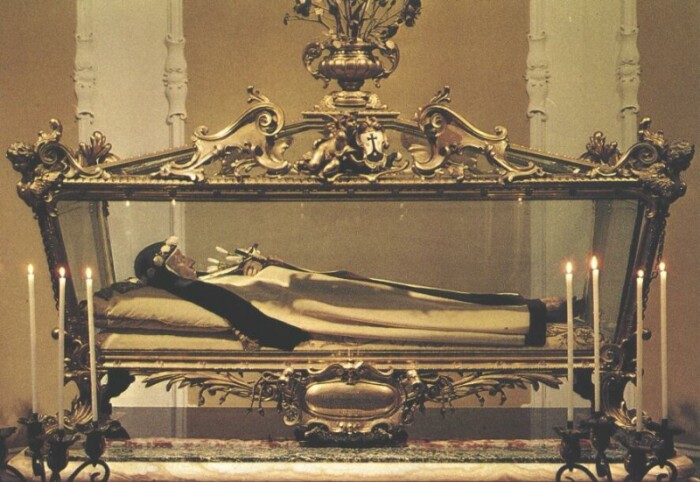
During the next two weeks several doctors and ecclesial authorities came to the crypt to examine the body. As the days continued to pass the body regained more and more the characteristics of a living being. The Archbishop of Florence came on March 21 to make his own examination. The body was now totally subtle. Her bright blue eyes could be seen under lids slightly opened. Finally a little moisture collected on her upper lip. It was wiped off with a piece of cloth and rendered a “heavenly fragrance”. The Archbishop declared: “Extraordinary! Indeed, it is a miracle to see a body completely flexible after death, the eyes those of a living person, the complexion that of one in the best of health. Why, even the soles of her feet appear so lifelike that she might have been walking about a few minutes ago. She appears to be asleep. There is no odor of decay, but on the contrary a most delightful fragrance. Indeed, it is the odor of sanctity.”
Teresa Margaret was finally buried eighteen days after her death. The report of miracles attributed to her intercession began immediately. Thirty-five years later, on June 21, 1805, the Feast of the Sacred Heart, the incorrupt body of St. Teresa Margaret was transferred to the nuns’ choir in the Carmel of Florence where it remains to this day.

Martyrs of Compeigne
Martyrs of Compeigne (+1794)
In the choir of virgin-martyrs, who forever sing the praises of the Lamb of God whom they followed unto the very end of sacrifical love, are our CARMELITE NUNS OF COMPEIGNE, FRANCE. The cultural and civil conflicts of their time were centered in the time of the French Revolution which began in July of 1789, with the fall of the Bastille. The new governmental Assembly of anti-religious hostility was the beginning of this great “Reign of Terror” as this time in world history is often referred to.
The community of Carmelite Nuns at Compiegne had been established in 1641, a daughter house of the monastery of Amiens. The community rapidly flourished and was renowned for its fervor and fidelity to the spirit of St. Teresa of Jesus, the Mother of the Discalced Carmelite Order. From its beginnings it enjoyed the affection and esteem of the French court, until the fatal turn of the French Revolution, when they then became, along with all other religious groups, the object of hatred and scorn. The anti-religious views of the new regime was proved by their proclaiming the vows taken by religious as null and void. Despite growing hostility, the nuns of Compiengne continued to live their religious life and refused to abandon their religious habit. Rumors of riots taking place in Paris continued to reach the nuns, which warned them of the growing and dire situation at hand. Officials of the newly appointed local government visited the Carmelite monastery of Compiengne with the intention of inspecting the monastery grounds and interviewing each of the nuns, while soldiers kept guard outside. The nuns were offered full freedom from the ‘so called vows’ with a suitable pension should they wish to leave the convent. They one and all refused this offer.
Realizing the gravity of this situation in which they were now in, their dynamic and discerning Prioress, Mother Teresa of St. Augustine, read the signs of the times accurately and was inspired to prepare the community for the supreme sacrifice should the need arise. They then sent in a formal document to the District Directory, stating that they wished to live and die as professed Carmelite nuns. As a community, in Easter of the year 1792, the nuns of Compiengne (numbering 21 at the time) offered themselves to God as a holocaust “to placate the anger of God, so that divine peace brought on earth by His Beloved Son would return to the Church and to the state.”
Hearing of the eviction of many religious from their monasteries, Mother Teresa decided to make preparations for a similar emergency. She rented rooms in friendly houses and paid for them in advance. She also obtained secular outfits for the nuns in case they were obliged to discard their religious dress. These precautions were taken none too soon as on September 12, 1792, local officials systematically searched the house and took whatever valuables they could find. On September 14, the property was confiscated and the nuns forced to adopt secular dress.
With apartments rented in four houses, the community divided into four separate groups, where they did their best to remain faithful to the Carmelite life in the situation in which they found themselves. Secretly they were provided with a new chaplain in the person of Fr. de la Marche, S.J. Dressed in disguise, he would meet the nuns secretly at the parish church and offer Holy Mass for them. The Mass, more than anything else, prepared them for their personal sacrifice in union with the Crucified Savior.
In July of 1794, sixteen nuns of the Community of the Carmel of Compiegne were arrested and brought to Paris in carriages. After spending two nights in the Conciergerie, on July 17th, the nuns were brought to trial and condemned to be executed a few hours later. The reason given by the judge was this: “You are to die because you insist on remaining in your convent in spite of the liberty we gave you to abandon all such nonsense.” “We have now heard the true reason for our arrest and condemnation,” one nun spoke out. “It is because of our religious beliefs that we are to die. . . .”
In the interval between their condemnation and execution the nuns asked for a pail of hot water to wash their soiled clothing. They removed their civilian garb and put on their religious habits which was to give witness to their religious profession. With a roll of the drums the cart bearing the condemned nuns to execution emerged from the prison courtyard. As they awaited the guillotine, each Sister knelt before the Prioress and asked her permission to die. They kissed her scapular and a little statue of Our Lady which she held out to each one as they renewed their vows for the last time on earth. Then they began chanting the Laudate Dominum, the Salve Regina, and the Magnificat.
Each of the Sisters, one by one, beginning with the youngest willingly placed themselves on the block of the scaffold, making an offering to God of their lives on behalf of the people and in union with the Sacrifice of Jesus. The Prioress was given the option of being the last to die. After she had encouraged each of her community and received their vows she knelt down and renewed her religious profession in a clear voice and kissed the statue of Our Lady as the others had done. With heroic courage she mounted the scaffold chanting the Salve Regina until her voice was silenced on earth . Then began the eternal canticle in heaven!
Within ten days of the execution of the Carmelites, many of those who had sat in judgement of them and had them condemned to death were themselves brought before a tribunal and sentenced to death. By the end of August the reign of the guillotine had come to an end. Without a doubt it was the victorious offering and martyrdom of the Carmelite nuns of Compiegne which ended this “Reign of Terror.” As Mother Teresa of St. Augustine was wont to say: “Love will always be victorious. The one who loves can do everything.”
The feast of the Carmelite Martyrs of Compiegne is celebrated on July 17th, the day of their martyrdom.
More coming soon…
More coming soon…
St. Mary of Jesus Crucified
St. Mary of Jesus Crucified
ST. MARY OF JESUS CRUCIFIED (Mariam Boaouardy) has her roots in the Holy Land. Early in her life, we see much suffering amidst not only her poor and humble background–the difficulties of Christian life (being a minority)–but even the loss and death of both of her parents when she was only two years old. Her parents died within days of each other, leaving Mariam and her newly born brother, Paul, orphans at a young age. A paternal uncle who lived in Abellin welcomed Mariam into his home as his adoptive daughter. Paul was adopted by a maternal aunt who lived in Tarshiha. From the day the two children were separated they never set eyes on one another again.
Not long after this, little Mariam moved with her adoptive parents to Alexandria in Egypt where she slowly grew up under their care and in the company of her cousins. In the family her religious inclinations developed, and by the age of 7 she was going to weekly confession and made her First Communion just before she was 8.
According to the oriental practice of the time, Mariam’s uncle had betrothed her to a cousin living in Cairo when she was only 13 years of age. Everything was settled and made ready for the marriage but the young girl proceeded to surprise everyone by refusing to wed. She wished to remain a virgin for Christ. Confiding to a friend and Muslim family servant she knew, she was invited to their home for a meal. Conversation turned to her awkward situation and her hosts offered to help her, on condition that she convert to Islam. Of course Mariam refused, so the Muslim man, filled with rage, beat and wounded her gravely on the neck with a sword. Then her lifeless body was left in a deserted alley. She later testified to the fact that a mysterious lady took her in and looked after her for about a month. She bore a deep scar across her throat all her life.
Mariam then fled for safety in other towns, looking for humble work as a servant to support herself, which she did for some time. Later through the direction of a priest, she was encouraged to enter religious life. Known for her seriousness and virtue, at the age of 20 she was accepted by the Sisters of St. Joseph of the Apparition, whose mother house was in Marseilles. Mariam was happy in the community and was made most welcome for her simplicity and hard-working attitude. Apart from the events of everyday life, other more unusual phenomena were observed, such as raptures and stigmata. After two years of postulancy, it was decided that she should be sent away: one reason was that they felt these external phenomena were not suited to the contemplative cloistered life rather than in an active community.
Mariam then applied to the Carmel of Pau, where she was received as a lay sister (because she was illiterate) and given the name Sister Mary of Jesus Crucified. Mother Elijah, her novice mistress, testified about her: “I can but paint a half-portrait. It would take another pen, more skillful than mine, to describe this beautiful soul, her ingenuousness, simplicity, humility, generosity, charity and her love for God and neighbor; her long-suffering in trials, her faith in God, her constancy in waging battle with the foe who never leaves her alone; her love for the hidden life so common and ordinary. One would have to live with and follow this child to get an idea of her.”
In August of 1870, St. Mary of Jesus Crucified accompanied a group of nuns to India, where they were to make a foundation in Mangalore. But Sister Mary was eventually sent back to Pau due to misunderstandings and suspicion. She later went on, through the inspiration of the Holy Spirit, to lead two foundations: first to Bethlehem, the holy site of the Birth of Jesus; then to Nazareth, where Jesus led his hidden life of 30 years. Being the only native Arabic speaker, she was put in charge of overseeing the workmen and the building of the monasteries.
Frequent ecstasies, apparitions and the stigmata were experienced by Sister Mary. But above all, it was her earnest quest for God through a life of faith, hope and charity which has marked her as so outstanding and inspiring a witness. At the age of 33, on August 26, 1878, Mary of Jesus Crucified entered into eternal life after much suffering and illness. Witnesses testify to her transpierced heart which was removed shortly after her death. May this “Flower from the Holy Land” intercede on our behalf. Her feast is celebrated on August 25th.
More coming soon…
More coming soon…
St. Teresa Benedicta of the Cross (Edith Stein)
St. Teresa Benedicta of the Cross (Edith Stein)
ST. TERESA BENEDICTA OF THE CROSS (Edith Stein) was born in 1891 in Breslau, which was then a part of the German Empire. Today the city is known as Wroclaw, Poland. Edith’s family members were very devout Jews, but Edith herself had no interest in religion and abandoned Judaism in her early teens. She says of herself: “During my early years I was mercurially lively, always in motion, spilling over with pranks, impertinent and precocious, and at the same time intractably stubborn and angry if anything went against my will.” An over-achiever gifted with a brilliant intellect, she earned a doctorate in philosophy at the University of Gottinngen in 1916. One evening, at the home of some Christian friends, she picked up the autobiography of St. Teresa of Avila. Fascinated, she read the entire volume in one sitting. Closing the book, she declared: “This is the truth.” The next day, she bought a catechism and began to study the Catholic faith. She was baptized in 1922 and started teaching at a Dominican girls’ school in Speyer. She then was appointed a lecturer at the Educational Institute of Munich but was forced to resign her position under pressure of the Nazi government. In 1933, Edith entered the Carmel of Cologne and took the name Teresa Benedicta of the Cross.
In an attempt to keep her safe from Nazi persecution of the Jews, she was sent with her sister, Rosa, from Cologne to the Carmelite monastery in Echt, Netherlands in 1938. However, the Nazis conquered Holland in 1942, and, in retaliation for the Dutch bishops’ denouncement of their racism, they arrested all Dutch Jews who had become Christians. St. Teresa Benedicta and Rosa were deported to Auschwitz and died in a gas chamber on August 9, 1942.
The writings of St. Teresa Benedicta fill 17 volumes, many of which have been translated into English. She was a woman of integrity, who followed the truth wherever it led her. St. John Paul II wrote of her: “This woman had to face the challenges of such a radically changing century as our own.” He canonized her in 1999. Her feast is celebrated on August 9.
More coming soon…
In her book entitled Woman, St. Teresa Benedicta praises Our Blessed Mother as the model woman, unique in her vital, maternal role in salvation history and in the life of the Church: “Mary is the most perfect symbol of the Church because she is its prefigurement and origin. She is also a unique organ from which the entire Mystical Body, even the Head itself, was formed. She might be called, and happily so, the heart of the Church. . . . Mary is our mother in the most real and lofty sense which surpasses that of earthly maternity. She begot our life of grace for us because she offered up her entire being, body and soul, as the Mother of God.” St. Teresa Benedicta understood that the maternity and bridehood of the Virgo-Mater was continued in her life as bride of Christ.
St. Raphael Kalinowski
St. Raphael Kalinowski
ST. RAPHAEL OF ST. JOSEPH (Joseph Kalinowski) was born to Polish parents in Vilna, Lithuania in 1835. He attended the university in Vilna, where, for a time, he fell away from the practice of his faith. He was a military engineer in the Polish army and took part in the uprising against Russia in 1863. Captured by the Russians in 1864 and condemned to ten years of forced labor in Siberia, he proved himself to be a person of extraordinary compassion and charity for his fellow prisoners by caring for them in their illness and giving them his meager portions of food.
Released when he was 39, he taught school in Vilna, then became a tutor to the Polish prince, August Czartoryski, in Paris. August was later to renounce a diplomatic career in order to follow his vocation to the priesthood. The young prince, whom Raphael cared for, and to whom he offered encouragement and spiritual guidance, was to become a very holy Salesian priest and was himself beatified in 1927.
St. Raphael entered the Carmelite Order in Linz in 1877 at the age of 42. He was ordained a priest in 1882 and, shortly after, was elected prior of Czerna. His contemporaries described him as “a living prayer.”
For the next twenty-five years in Carmel, he was a preacher, an administrator, a confessor, and spiritual director. When hearing confessions, he was like a father to his penitents, addressing them as “my child” or “my dear child.” For him, the Sacrament of Confession was a “treasury of divine mercy.” At every request, he was ready to hear confessions, and his confessionals were places of numerous conversions.
Renowned for his sanctity and his heroic status in Poland due to his years in Siberia, Raphael greatly popularized the Order and is credited with bringing about its restoration in Poland. He was distinguished in his zeal for the advancement of the Church, his efforts toward Church unity, and, in particular, his love of Our Lady, Queen of Poland. For him, devotion to Mary was the yardstick of progress in the way of perfection. She was the visible sign of the action of the Holy Spirit in souls and participated, in a particular way, in the process of their sanctification. He died in Wadovice in 1902 at age 72 and was canonized by St. John Paul II in 1991. His feast is observed on November 19.
More coming soon…
More coming soon…
St. Teresa Margaret Redi
St. Teresa Margaret of the Sacred Heart
ST. TERESA MARGARET OF THE SACRED HEART (Anna Maria Redi) was one of the brightest stars in the Carmelite Order of the eighteenth century. She was born in Arezzo in Tuscany in 1747. Her family was of the lower nobility of the time and moderately wealthy. Anna was well mannered and refined, simple and innocent, quiet and unassuming but could be vivacious and, on occasion, somewhat mischievous.
Her vocation to Carmel was revealed to her when, saying goodbye to a friend who was entering Carmel, she heard in her heart these words: “I am Teresa of Jesus and I want you among my daughters.” Distressed and upset she fled to the tabernacle, where she again heard the voice saying: “I am Teresa of Jesus and I tell you, in a short time you will be in my monastery.” On September 1, 1764, at eighteen, Anna Maria entered the Carmel of Florence. Characteristically, she bought a pair of long red gloves to wear at a party she attended the night before her entrance. She was a model religious with an astonishing depth of spirituality, purity of heart, humility, and ardent love for the Sacred Heart of Jesus. She was given a special contemplative experience of the words of St. John, “God is love,” and she lived in fidelity to this experience by a hidden life of love and self-gift. Her love of God was powerfully expressed in her love for her sisters, to whom she gave herself in dedication and service. Appointed Infirmarian, she cared for the ill and elderly of her community, even the most difficult, with gentleness, equanimity, and patience.
True to the tradition of the Order, Teresa Margaret was utterly devoted to Our Lady whom she regarded as the model and protectress of her own virginal purity. She died in 1770 at 23. Pope Pius XI canonized her on March 13, 1934. Her feast is kept on September 1.
For an extended biography, see here: https://lafayettecarmelites.org/st-teresa-margaret-of-the-sacred-heart-extended-biography/
Saint Teresa Margaret of the Sacred Heart was born into a large devout family in Arezzo Italy in 1747. From the earliest days of her childhood, Anna Maria[1] was filled with a deep love of God questioning the adults around her as to “Who is God”? Already she was dissatisfied with answers given her. Only the contemplative life of a Carmelite nun could begin to quench her thirst to know and give her self completely to God. Her entire life was driven by the desire to “return love for love”. She entered the Carmelite convent in Florence at the age of seventeen, advanced rapidly in holiness and died an extraordinary death at twenty-two. Her spiritual director reflecting on her death remarked “she could not have lived very much longer so great was the strength of the love of God in her”.
The cornerstone of St. Teresa Margaret’s spirituality was to remain hidden, to appear just like everyone else in spite of her heroic virtue. To our loss, she has remained very much hidden even after her death. Fr. Gabriel of St. Mary Magdalen commented “This is an odd fact, for we do not hesitate to rank her among the primary figures who represent the glory of Carmel – among Teresa of Jesus, John of the Cross, and Thérèse of the Child Jesus.”
Though St. Teresa Margaret led a life of exquisite holiness and purity, it was also a life that is wholly imitable. In her were combined Martha and Mary as she served her community as infirmarian while reaching the heights of contemplation. No one will come to know St. Teresa Margaret without their own spirit being renewed and reinvigorated.
________________________________________
[1]St. Teresa Margaret’s name in the world was Anna Maria Redi. There was a nun in her convent named Mother Anna Maria who is mentioned several times in this web site who should not be confused with our saint.
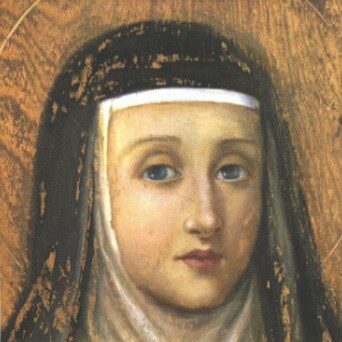
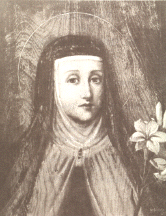
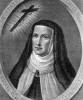
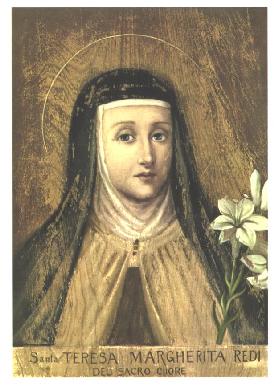
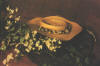
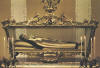
Quotes from and about Saint Teresa Margaret[1]
“Lord,I shall be yours, whatever the cost, despite all repugnance.” Page 41.
Preparing to enter Carmel
… the Prioress suggested that, for one intending to enter Carmel, she could think of no better practice than “to accustom herself to mortify her own will in all things, however trifling, and to yield willingly her own rights in order to convenience others, pleasantly agreeing with their opinions, treating all with a genuine kindness, thus making a continual and entire sacrifice of the self to God.” … Anna Maria (St. Teresa Margaret) had now, from an authoritative source, the secret of the essential spirit of Carmel: the holocaust of one’s will, rather than the rigid adherence to exterior acts and mortifications… Page 42
She who is silent everywhere finds peace. Page 74
She who desires peace must see, suffer and be silent. Pages 74 & 109.
Rather than continually dwelling on her misery and worthlessness, she merely let all thought of self fall away before the infinite majesty of God; and truly the most profitable and genuine way of despising self is to forget oneself altogether. Page 79.
However, self-knowledge unlike self-love does not depress with the sight of one’s imperfections. “I can do all things in Him who gives me strength,” she repeated with St. Paul, refusing to be downcast. God could and would supply all she lacked, and Father Ildefonse testified: “The effect of self-knowledge did not discourage her, but rather forced her to throw herself on the goodness and mercy of God. She said to me once, ‘From myself, nothing; from God, everything … the smaller and weaker I am in myself, the richer and stronger I shall be in Him … He shall be the more glorious in His mercy as I am more despicable in my sins and nothingness.’” Page 80
On her practice of poverty and detachment, Teresa Margaret framed the following counsel: “Always receive with equal contentment from God’s hand either consolations or sufferings, peace or distress, health or illness. Ask nothing, refuse nothing, but always be ready to do and to suffer anything that comes from His Providence.” Page 81
She who does not know how to conform her will to that of others will never be perfect. Page 83
Let the nuns take great care not to excuse themselves for their faults except when absolutely necessary. By acting in this way they will make great progress in humility. Page 84.
“Knowing that a bride cannot be pleasing to her spouse unless she endeavors to become what he wishes her to be … I will always think of my neighbors as beings made in your likeness, produced by your divine love, redeemed at the price of your precious Blood, looking upon them with true Christian charity, which you command. I will sympathize with their troubles, excuse their faults, always speak well of them, and never willingly fail in charity towards them in thought, word, or deed.” Page 97
I am resolved to give complete obedience in everything without exception, not only to my superiors, but also to my equals and inferiors, so as to learn from you, my God, who made yourself obedient in far more difficult circumstances than those in which I find myself.” Page 97
“Habitual examination of conscience”
“I propose to have no other purpose in all my activities, either interior or exterior, than the motive of love alone, by constantly asking myself: ‘Now what am I doing in this action? Do I love God?’ If I should notice any obstacle to pure love, I shall take myself in hand and recall that I must seek to return my love for His love.” Page 131
“Since nature resists good, even though the spirit may be willing, I resolve to enter upon a continual warfare against self. The arms with which I shall do battle are prayer, the presence of God, silence; yet I am aware how little I am able to use these weapons. Nevertheless I shall arm myself with complete confidence in you, patience, humility and conformity with your divine will … but who shall help me to fight a continual battle against enemies such as those which make war on me? You, my God, have declared yourself my captain; you have raised the standard of the Cross, saying: ‘Take up the cross and follow in my footsteps.’ To correspond with this invitation, I promise to resist your love no longer; rather, I will follow you to Calvary without hesitation.” Page 132
On the Hidden Life
St. Teresa Margaret can almost be named “the saint of the hidden life,” so thoroughly did she absorb its meaning and mystery. The life of Jesus and Mary at Nazareth is indeed the model par excellence for all religious, but this silent and self-effacing saint penetrated deeply into it, and gave its application such wide horizons that she can really be said to have proposed something essentially original.
It is a commonplace to use the life at Nazareth as a type of the Hidden Life, because the enclosed religious is completely withdrawn from the world. But in this sense Jesus, Mary, and Joseph were not “hidden,” at least not from their neighbors and the inhabitants of Nazareth and its environs. Probably, like small country towns the world over, everybody knew and discussed the least event around the village well, and anything that happened in Joseph’s house would be common knowledge, as with everybody else. But where one can claim that their hiddenness was absolute was that while all their exterior activities were watched, and every visitor noted, so well was their interior life concealed from all eyes, that they passed for the most ordinary and unremarkable among a community that was in itself insignificant. The revelation of miraculous powers in Jesus was received with shocked disbelief. They had known him since childhood and could vouch for his likeableness, kindness, generosity, no doubt – but not sanctity, let alone divinity! This was Teresa Margaret’s method of practicing the “hidden life.” Everyone in the community saw all she did, talked with her, worked with her, and were warm in their praise of her goodness and charity. But the real depths of her interior life were completely hidden and were one day to prove a revelation and surprise to these intimate daily companions. She passed every minute under their very noses, so to speak, but managed to remain unnoticed, keeping her soul’s secret for God alone. Page 75
“Obedience,” said St. Gregory the Great, “is rightly placed before all other sacrifices, for in offering a victim as sacrifice, one offers a life that is not one’s own; but when one obeys one is immolating one’s own will.”… One may leave home, family, friends, renounce social position and material possessions, detach oneself from every created thing, but unless he dispossesses himself of his own will, the sacrifice is worthless … [and Teresa Margaret] developed what one biographer described as “the art of never doing her own will.” … She had a strong character and a warm, ardent nature, and she seemed to sense that the conflict between her own rebellious temperament and her desire for sanctity would be resolved by the perfection of her submission. Pages 85-86
“At the foot of the Cross,” wrote Father Gabriel of St. Mary Magdalene, O.C.D., “suffering becomes more a proof of love than a punishment. Teresa Margaret became a saint not through multiplying penitential exercise, but by having effected an uninterrupted adhesion of her will to the crucified Redeemer.” Page 135
Lest the fact that sympathy might provide some consolation – for it is well-known that a trial shared loses much of its cutting edge – she endeavored to conceal from those around her any pain or sorrow she endured, or the discomfort of fatigue, the weather, minor indispositions, or the small misunderstandings and inevitable frictions of community life. She continued to practice the incessant mortification of consistently presenting a smiling and serene exterior no matter how harassed she might be by interior sufferings or trials. Page 136
The grace of Deus caritas est
One Sunday after Pentecost, on the 28th of June, 1767, when Sister Teresa Margaret was officiating in choir, she read out the little chapter at Terce: “Deus caritas est.” She had heard these words repeatedly, Sunday after Sunday, for the past three years, but now it seemed as though she understood them for the first time – or rather, her understanding of them was raised to an entirely different plane. The verse struck her with the force of a revelation: “God is love; he who dwells in love dwells in God, and God in him.” This dwelling had been the goal of all her striving, seeking as she did to imitate the interior life and hidden operations of Christ. From that day onwards the necessity of proving her love by deeds became so compelling a force that it was obvious to her sisters that some special grace had been given her. “Nobody comes to the Father except through Jesus,” she said. “To come to God who is everything and consequently all good, no fatigue must seem to us too great; we must not be put off either by the difficulties we meet on the way, but accept bitterness and welcome every kind of cross with eagerness. By these means, which are precisely those of Jesus Christ, it is not difficult to come to the true God, to live in charity, to walk in love.”
Despite her customary reticence and assiduity in concealing any graces or spiritual favors, the fact that something out of the ordinary had taken place on that Sunday morning was apparent to all. For days the young nun seemed quite out of herself, and the sudden illumination that the words had sent flooding into her soul is difficult to explain, because of the seeming triviality of the incident and her own habitual silence about such things. It marked the beginning of a new stage in her spiritual life, as Father Ildefonse was quick to observe. From this time, he noticed that the quiet, self-possessed and reserved sister appeared to withdraw even more into herself, becoming engrossed in a silent, determined, and conscious awareness of the presence within her, and her endeavors to attain to perfect union with Him. However, this withdrawal was a purely spiritual matter, and there was no suggestion of cutting herself adrift from the community, for she continued to give herself wholeheartedly to all, in her services as infirmarian, in companionship and sympathy at recreation, and in never avoiding her share of work on the grounds of seeking more solitude.
Speaking to Father Ildefonse one day, she tried to express to him something of the significance those words God is love now held for her, but she became almost incoherent in her emotion. “Just as the soul in the state of grace (which is charity) is in God, God is in her. Just as the soul lives the life of God, so does God in a certain way live IN her. And so it is that between them there is but a single life, a single love … God alone! The difference is that God has all by essence, whereas the creature has it only by participation and grace.” And, adds Father Ildefonse, “Note that these words came from a simple child who had never studied and knew no theology apart from what her instinct taught her.” page 128
Father Ildephonse reflecting on her death remarked “she could not have lived very much longer so great was the strength of the love of God in her”. Page 88*
[1] All quotes are taken from God is Love (1964 edition) unless marked with an ‘*’ in which case they are taken from From the Sacred Heart to the Trinity.
Florilegio
Excerpts from The Florilegio of St. Teresa Margaret
I
On the Love of God
I am doing nothing to correspond to love…. I feel within me a continual reproach of the Sovereign Good, and on the other hand everything seems to hinder me from simply rushing forward to God. . . . I find no other remedy but to live by faith. I cannot imagine what painful fare living without love would be for one who burns with desire for this love. (Letter to Father Ildefonse, Dec. 19, 1768)
If I should see hell open for me, I should continue to love the Lord all the same. (Canonical Process: Words of the Saint)
It is enough to keep closed the outside doors, which are the senses; then it seems to me that the soul cannot go elsewhere than to its center which is God. (Canonical Process: Words of the Saint)
I propose, O my God, to have no other aim than love in all my actions, interior as well as exterior, remembering that I ought to render love for love. (Resolutions, 1768)
My only love, I abandon myself entirely to You, so that You alone may act in me according to your designs. (Ibid.)
Dispose of me as is most pleasing to You, provided that I follow You by the way of Calvary: the thornier I find it and the heavier Your Cross, the happier I will be. (Resolutions, 1768)
I believe that I cannot do less than marvel at the loving conduct of our good God in leading me to this holy place [Carmel] …. I thank Him for having rendered me victorious, and for having freed my heart from so many attachments, which would have separated it from the sole object in which it should rest. (To Mother Maria Anna of the Albizi in St. Apollonia’s, January 5, 1769)
We should not be disturbed, whatever the circumstances in which God places us, but let us allow Him to act, uniting ourselves to His intentions; in this way we will love with pureness of love. (Maxims of the Saint)
As he who loves a creature often thinks of her, so the one who loves God is always mindful of Him. (Maxims of the Saint)
All things count for nothing when it is a matter of acquiring true love of God. (Ibid.)
Let us do all for love, and nothing will appear difficult when we reflect that love desires nothing but love. (Ibid.)
To acquire this Love, which is God Himself, no labor should seem too arduous, nor ought one to draw back because of the difficulty one may encounter. (To Mother Anna Maria of St. Anthony of Padua)
The mirror in which we ought to look at ourselves that we may reach divine union is Jesus Christ, because no one can attain it except by means of and through the merits of Jesus Crucified. (To the same)
Consider the grace of God: in these plants He speaks to us without words, and reminds us to love Him. (To the sister near her in the garden)
When a sick Sister, with whom she was staying, urged her to go down to the Choir in time to prepare herself for Holy Communion, she replied: “It might be hard for me to remain here, but on the other hand I believe that since obedience wills me to assist here rather than in Choir, the faithful accomplishment of my duty will be the best preparation for Communion, for God is not restricted either to time or place.” (To Mother Teresa Maria of the Most Holy Conception)
If the actions of our neighbors have a hundred aspects, we ought always to consider them from the best point of view. (To the same)
When an action is blamable, let us excuse the intention. (To the same)
When as infirmarian she had to deny any sick Sister something that could harm her even slightly, she was wont to say: “Now is the time of offer Jesus this sacrifice which He is expecting from you.” (Souvenirs)
Try to be all for God’s with love, our Superiors’ with submission, our neighbor’s with charity. (To one of the Sisters)
Never complain of anyone, but turn the complaints against yourself; because if you do not succeed in doing what you long to do, how can you complain if others fail? (From the writings of the Saint)
I believe that love would render bearable, and even sweet, the torments of hell; because love alone makes one surmount everything, as was demonstrated by the holy martyrs. (To Father Ildefonse)
Love suffers neither delay nor repose, being always eager to suffer for the Beloved. (Maxims of the Saint)
Our good God ardently desires to give us the great treasure of His love; but He wants us to ask Him for it insistently, and to act in such a manner that each work we perform will be a request for this love. (Thoughts)
II
On Love of Neighbor
When one of the Sisters had received a public correction, the Saint went to her most tenderly, and to comfort her said: “Now is the time to accumulate merits for a blessed eternity, making of the unpleasant experience a little bouquet to offer Jesus, not thinking of yourself anymore, excusing and forgiving everyone.” (Souvenirs)
Let us remember that our Holy Mother founded our monasteries principally so that we might help by our prayer those who are laboring to lead souls to God. If we grow negligent in this, we shall completely fall away from her spirit, and the Holy Mother will not consider us as her daughters. (Words which the Saint frequently said to Mother Teresa Maria of the Most Holy Conception)
III
On Faith and Hope
What a beautiful thing to pray to Him who wants so much to give to us! . . . With our good Father it is enough to open one’s mouth and simply show Him our desire in order to be heard. … How can one do less to be heard? (Maxims)
It is extraordinary that our good Jesus, even when we are asleep, when we are amusing ourselves and are not thinking at all of Him or of ourselves, still continues to pray to His eternal Father for us! (Ibid.)
Let us remain quite calm so that however things turn out they will always be to our advantage since God always arranges what is best for us. (To one of the Sisters)
Let us place all our trust in God, and let us remember that it is of faith that God gives us strength in proportion to the work. (To one of the Sisters)
Don’t you see how God helps us, and at the end of the day everything is accomplished? (To one of the Sisters)
I wish to live by faith in You, O Lord …. and I hope in the end to be saved! (Canonical Process: Words of the Saint)
You unbeliever, O you who do not dare draw near to Him, make the test and prove how good and generous is our most loving God! (Canonical Process: Words of the Saint)
IV
On Humility
The poorer and more miserable I am, so much the more am I rich and strong in God. (Canonical Process: Words of the Saint)
God will be more glorious in His mercy, the more vile and contemptible I am in my nothingness, in my sins, and in my weaknesses. (Ibid.)
In what can we not humble ourselves after a God has so humbled Himself for us? (Ibid.)
Especially at the end of her life she was accustomed to say: “If they knew what I am, they would not live with me, because I am so wicked.” (Ibid.)
When something goes well, let us not believe that it is because of our prayers; but when some misfortune occurs, let us think that it is because of our sins. (Thoughts)
The spirit of Jesus is a spirit of subjection, simplicity, humility, and of meekness. (Thoughts)
Let us seek that love which created and redeemed us, and commands us to love Him. If we long to find Him, the way is this: humility of heart and simplicity of spirit. (To the Sisters)
Since love makes lovers conform, therefore we ought to become humble like Jesus, meek like Jesus; and His humility will teach us to rejoice when we are despised and to be silent when nature leads us to excuse ourselves. (To the Sisters)
It is a great thing that our good Jesus, even though He is glorious at the right hand of His Father, takes on Himself our most vile miseries and deigns to intercede continually for us. (Canonical Process: Words of the Saint)
V
On Obedience
She herself declared she wished to live by pure obedience, and therefore in all that she did she endeavored to be able to say to herself: “I am doing this through obedience and with obedience.” (Canonical Process: Deposition of Father Ildefonse)
If they work here [in the monastery] only through obedience, it does not seem to me that God can allow His work to be impeded [namely that exterior occupations would be an obstacle to union with Him]. (To Father Ildefonse)
VI
On Poverty
When she [the Saint] was insistently asked by her father, who wanted to give her a present, what she would like, she replied: “I desire nothing and I need nothing. You have made me such a beautiful gift in allowing me to wear this Holy Habit, that if I remained with my face to the ground from morning to night in gratitude, I should still be doing less that I ought.” (Canonical Process)
In the last hours of her life the doctor ordered some drops of laudanum to be given to her. She received them with gratitude saying that the medicine was too good and precious for a poor Discalced Nun, and that she did not merit so much attention. (Canonical Process: Deposition of Mother Teresa Maria)
VII
On Silence
Whoever desires peace, let her watch, suffer, and be silent. (To the Sisters)
If we wish to become holy, let us work and endure in silence, keeping our soul in peace. (To the Sisters)
When one cannot put oneself right by speaking, it is better to have recourse to prayer and silence; and thus to keep one’s peace alone with God. (To the Sisters)
Whenever there was some trouble in the monastery the Saint was unwilling to talk about it and used to say: “Prayer and silence!” (Souvenirs)
VIII
On Mortification
There is such need to mortify the intellect, the memory, and the exterior senses, so that they become almost spiritual, and then united to the soul they find in God alone their nourishment and their consolation, and they can say: “My heart and my flesh have exulted in the living God.” (Maxims)
The Saint made the resolution never to let pass an occasion that presented itself to suffer, and to suffer as far as possible in silence, keeping it between herself and God. (Canonical Process: Deposition of Mother Anna Maria of St. Anthony of Padua)
IX
On Devotion to the Sacred Heart and to the Most Holy Eucharist
The Saint regarded the Sacred Heart as the center of the love with which the divine Word loved us from all eternity, making such devotion consist in loving It unceasingly. She wanted to be called ‘of the Sacred Heart,’ intending by this to wish neither to live nor breathe except to love It with all her strength. (Canonical Process: Deposition of Father Ildefonse)
Yes, my God, You know well that I long only to be a victim of Your Sacred Heart, entirely consumed as a holocaust in the fire of Your holy love! (Resolutions)
Your Heart will be the altar of this, my consummation in You O my God; and You will be the priest who will immolate this victim in the fire of Your holy love! (Ibid.)
Since, O my God, You inspire me to make myself like you in everything, as much as I can, I want particularly to imitate You in those virtues that are so pleasing to Your most loving Heart, namely: humility, meekness, and obedience. (Resolutions)
X
On Devotion to Most Holy Mary
“Let them recommend themselves to God,” the Saint used to say of the religious, “and they will see He will console them. Let them have recourse to the intercession of Most Holy Mary in all their necessities and they will always be heard.” (Canonical Process: Deposition of Mother Teresa Maria of the Most Holy Conception)
The Saint used to place her patients under the care of the Most Blessed Virgin, after which she remained tranquil, saying: “Let them also confide in Her assistance, because they are in good hands.” (Ibid.)
Bless us, O Virgin Mary, Mother of Compassion, Advocate and Consoler of all those who confide in You! (Affections)
Mother of Mercy, give us strength against the enemies of our souls, so that by your aid we may always be victorious. (Ibid.)
XI
On Various Subjects
How is it possible that men can commit what is an offense against God? Oh! It cannot be true, they cannot have had the intention of doing evil! (Words of the Saint)
All things come to an end; therefore take heart, for just as one thing gives way to another, so eternity will come at last. On the contrary seeing how quickly the things of this world end ought to console us, because we are drawing ever nearer to that goal to which all our works ought to tend. (To one of the Sisters)
- I will perform no action with haste or perturbation.
- I will fix my eyes in my heart, and raise my heart to God.
III. I will speak softly and only of necessary things. (Resolutions)
“One must take care,” so the Saint used to say, “to make use of spiritual direction for what is just strictly necessary, because many times it happens that one begins the conference on a spiritual plane and ends up in self love.” (Canonical Process: Deposition of Mother Teresa Maria of the Most Holy Conception)
If we live and move in God, it does not seem to me that His company and His love can hinder us from moving and working externally. (To Father Ildefonse)
Lord, give me greater patience that I may be able to suffer still more for You. (Words of the Saint as she was dying.)
[1] The Florilegio of St. Teresa Margaret is a booklet of sayings translated from the Italian by Sister Miriam of Jesus, O.C.D. This booklet is available for sale. Send $2 to:
Carmel of Maria Regina
87609 Green Hill Road
Eugene, Oregon 97402
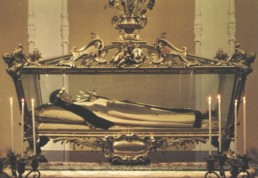
The Incorrupt Body of St. Teresa Margaret
What follows is an abridged narration of the extraordinary death of Saint Teresa Margaret.[1]
Four months before her death, Teresa Margaret had made a pack with Sr. Adelaide, an elderly nun she was caring for. The pact was that when she died, Sr. Adelaide would ask God “to permit Sister Teresa Margaret to join her quickly in order that she may love Him without hindrance for all eternity and be fully united with the fount of divine charity.” Less than four months after this incident, Teresa Margaret was indeed with Christ in God. No one is sure but it is believed that the cause of Teresa Margaret’s death was strangulated hernia. If the cause of her death actually was hernia, it is more than likely that it was in lifting the heavy, inert body of Sister Adelaide that she strained herself; in which case, it provides a delightful “seal” to their simple pact.
It is not easy to decide that at this stage she had a definite premonition of the imminence of her death, but a strange incident is recorded at about the same time. A former acquaintance, Teresa Rinuccini, who was about to enter the Benedictine Monastery of St. Apollonia, had been doing the rounds of the convents in Florence, making the customary conventional farewell visits. On leaving the Carmel parlor where she had been talking to Teresa Margaret, Teresa said: “Before taking the habit, I will come and see you once more.”
“If you can see me,” was the enigmatic reply.
“Why, what do you mean?” asked the visitor, surprised. “Will Mother Prioress be displeased if I visit you again?”
But Teresa Margaret changed the subject, and would not explain her cryptic remark. Yet her unexpected prediction was fulfilled. Before Teresa could make a second call, Teresa Margaret was dead…
On Sunday, the 4th of March, she asked Father Ildefonse to allow her to make a general confession, as though it were to be the last of her life, and to receive Communion the following morning in the same dispositions. Whether or not she had any presentiment that this was indeed to be her Viaticum one cannot know; but in the event it proved to be so.
Teresa Margaret was twenty-two years and eight months of age, in excellent health, never having had any serious illness or even the threat of one. She was tall, well-built, robust, with a clear, fresh complexion and vivacious manner. The overwork and lack of sleep during the past few years had left no trace of physical exhaustion; she was bright, alert, and active. In fact, many marveled at her resilience and stamina, and Mother Anna Maria once remarked that she seemed to thrive on hard work, which had the effect of strengthening rather than fatiguing her.
Yet in the full bloom of healthy, young womanhood, she suddenly and inexplicably made these elaborate preparations for an imminent and precipitate death.
[It was March] The Lenten fast had not ended, and the evening meal was quickly disposed of. When Teresa Margaret reached the refectory, the community had finished their collation and departed, dispersing to perform their various chores before assembling for evening recreation. There was a piece of fruit and some bread under her folded napkin. She went to the serving hatch and fetched her bowl of soup from the kitchen where it had been left to keep hot and took her seat in the otherwise deserted room. Immediately as she began to eat the simple meal, an acute abdominal pain almost doubled her up. She rose to leave the refectory, but realized that she could not manage to climb the stairs to her cell. Entering a room nearby, she waited until the first violence of the attack had passed, then made her way upstairs. As she closed the door of her cell another spasm overwhelmed her, and she fell on to the floor, unable to reach the bed on the opposite side of the room.
Sister Mary Victoria, who was assistant infirmarian, happened to pass through the corridor just in time to hear Teresa Margaret’s call for help. Entering, she found her lying on the floor, writhing in pain. Within a matter of minutes she had summoned help, and, assisted by many hands, the sufferer was undressed and put into bed and the doctor summoned. He was not alarmed, but merely diagnosed a bout of colic – extremely painful, he agreed, but in no way serious. He prescribed a mild sedative, and advised that she should drink plenty of liquid. Then he left, with the assurance that if she followed these directions the colic would pass and there would be no complications.
Teresa Margaret did not sleep at all during the night, and she tried to lie still so as not to disturb those in the adjoining cells… With her usual exactitude she followed the doctor’s direction quite literally, and consumed an amazing quantity of liquid. Earlier in the evening she had been given broth and barley-water, and during the night two flasks, one of well water and another of mineral water, had been left with her; she drank the entire contents of both. It is hardly surprising that this course of hydro-therapy increased rather than lessened her sufferings. Her face and body were bathed in perspiration, but when Mother Anna Maria came first thing in the morning to see her, she seemed to have taken a slight turn for the better. She was less oppressed by pain, and seemed even inclined to talk a little.
Later in the morning Doctor Pellegrini returned, but as soon as he saw the patient his optimism evaporated. By this time her internal organs had become paralyzed, and after an examination he announced gravely that he would have to call in the services of a surgeon … the remedy for all ills seemed to be, when in doubt, draw some blood. Leeches were applied as relief for the most astonishingly varied ailments from asthma to sunstroke. So now the medicos proceeded to bleed Teresa Margaret’s left foot. A vein was opened, and there was a sluggish flow of congealed blood. And then for the first time it dawned upon Doctor Romiti the surgeon, how grave her condition was. Taking Sister Magdalene aside, he advised that the sister should receive the Last Sacraments without delay. She, however, felt that this was not necessary, and was reluctant to send for a priest because of the patient’s continued vomiting. Also Sister Teresa Margaret’s pain appeared to have lessened, and she suggested that instead of preparing for her death, he should endeavor to cure her. The seeming asperity of this reply was probably due to anxiety, but she passed on his message to the Prioress, who seemed to share the infirmarian’s opinion, for, strangely, none of them made any attempt to have a priest summoned.
The apparent improvement in her condition was, in fact, due to an internal hemorrhage which gave temporary relief to the congested organs, but nobody suspected this. The spasms of pain lessened, but only because she herself was growing rapidly weaker, and her general condition deteriorating alarmingly.
The patient offered no comment, nor did she ask for the Last Sacraments. She seemed to have had a premonition of this when making her last Communion “as Viaticum” the previous Sunday. She held her crucifix in her hands, from time to time pressing her lips to the five wounds, and invoking the names of Jesus and Mary, but she continued to pray and suffer, as always, in silence.
By 3 p.m. her strength was almost exhausted, and her face had assumed an alarmingly livid hue. Thoroughly frightened now, the Prioress sent hastily for Father Covari, a Dominican, who was then extraordinary confessor to the convent. He arrived in time to anoint the young nun, pronouncing in the name of the Church those portentous words of release which down the centuries have echoed for the departing soul the cry of the dying Christ: “Into thy hands I commend my spirit.” “Go forth, Christian soul, from this sinful world, in the name of God the Father Almighty who created you; in the name of Jesus Christ, Son of the living God, who suffered and died for you; in the name of the Holy Ghost, who sanctified you.”
Silent and uncomplaining to the end, with her crucifix pressed to her lips and her head slightly turned towards the Blessed Sacrament, Teresa Margaret took her flight to God.
All the nuns, kneeling huddled against each other in the confined space of the little cell, seemed stunned with the suddenness and unexpectedness of it all. A passing fit of colic … in a few hours they had expected to see her moving once more through the corridors, serene and kindly as ever. The Prioress’ hands trembled as she closed the door after the departing community.
“Mother Anna Maria,” she said quietly, laying a detaining hand on the other’s arm, and drawing her aside. The two stood gazing down on the familiar face, quiet and still now, but almost unrecognizable under that ghastly discoloration. They turned the bedclothes back. The hands and feet were almost black. Her body seemed to be decomposing almost under their eyes.
“You must arrange for the funeral without delay, Mother,” said Mother Anna Maria quietly. “It would be most unwise to leave her body for any length of time.”
“Yes, but the obsequies …?”
“There’s nothing to be done but hurry them forward.”
Deftly, and as quickly as possible, they clothed the already rigid body in the serge habit and enfolded it in the white choir mantle, now to be her shroud. Her billet of profession and crucifix were placed in the still hands folded on her breast, and a wreath of white flowers laid on her head over the black veil.
Suddenly the complete silence that hung heavily over the monastery was shattered by the sound of the house bell. At the summons for which all had been waiting, the community assembled quickly, wearing their choir mantles and holding lighted candles to form a procession in the cell, where the cross-bearer stood at the head of the sister who, twenty-four hours before, had been walking down this corridor. It was not easy to concentrate on the prayers with their reiterated reminders that it is death which, opening onto infinite horizons, gives life its ultimate meaning and purpose.
“Deliver me, Lord, from everlasting death in that dread day when heaven and earth will rock and thou wilt come to judge the world by fire. I tremble and am full of fear as I await the day of reckoning, that day of wrath, calamity, and sorrow…
Reverently they laid the pallet on the simple bier – two trestles covered with a black cloth – at each corner of which stood a large candlestick in which mournful brown candles flickered sullenly. The bare feet were near the open grille, and two of the nuns took their places, kneeling beside the almost unrecognizable head of their deceased sister, to begin the perpetual vigil which would end only when they laid her body in the tomb.
As the Prioress sprinkled the still form with holy water, she uttered a silent, unrubrical prayer that the rapidly approaching corruption of that once lovely body would be arrested until tomorrow, so that no unseemly accident should mar the grave solemnity of the ceremonies.
The bier was raised, and slowly the procession wended its way to the crypt for the burial. And now, after a lifetime of silent self-effacement, God lifted the veil beneath which His humble, unassuming spouse had so long concealed herself from all eyes. She was His, and He had a mission and message to pass on to us through her. This He now proclaimed, in the words of Pope Pius XI, “with that powerful voice of miracles, which is indeed His voice.”
Surely, of all the wonders worked by Almighty God through this most unassuming instrument, none has been more outstanding than the preservation of her own body, after the apparent symptoms of early decomposition that everyone had observed with such alarm. Yet now, as they entered the vault, all noticed that there was another change taking place in the face; the alarming blue-black discoloration was much less pronounced, and, temporarily, the burial was postponed. Within a few hours another examination revealed that face, hands, and feet had regained their natural coloring, and the nuns felt immensely consoled to see that lovely, childlike face looking once more as they had always known it in life.
They begged the Provincial’s permission to leave her unburied until the next day, a request which he, dumbfounded at this astonishing reversal of natural processes, readily granted. The final burial of the body was arranged for the evening of the 9th of March, fifty-two hours after her death. By that time her skin tint was as natural as when in life and full health, and the limbs, which had been so rigid that dressing her in the habit had been a difficult task, were flexible and could now be moved with ease.
This was all so unprecedented that the coffin was permitted to remain open. The nuns, the Provincial, several priests and doctors all saw and testified to the fact that the body was as lifelike as if she were sleeping, and there was not the least visible evidence of corruption or decay. Her face regained its healthy appearance, there was color in her cheeks. Suddenly the real depth and wealth of the hidden, silent, self-effacing life that had been lived in their midst, in charity, humility and never-failing kindness which each had experienced at some time, dawned in full force on the nuns, when they understood the import of what was happening. Mother Victoria, who had been Prioress in 1766 and received the profession of this young nun, and had later been the recipient of her loving ministrations in the infirmary, suggested that a portrait should be painted before the eventual burial. This was unanimously agreed to, and Ann Piattoli,[2] a portrait painter of Florence, was taken down to the crypt to capture forever the features that looked so serenely life-like in death.
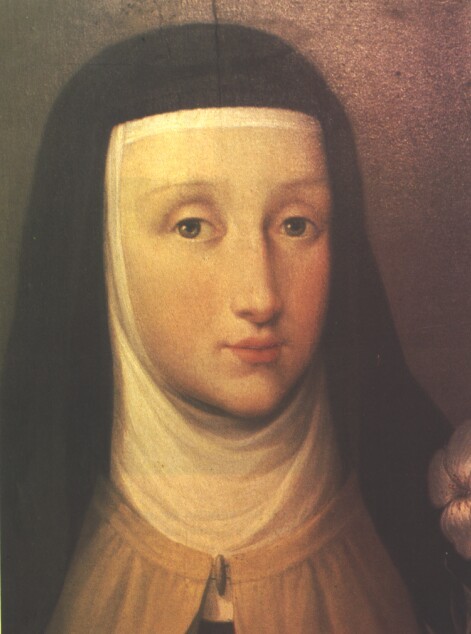
The Carmel burial vault was a scene of much coming and going during these days, and had assumed anything but a mournful atmosphere. By the time the painting was completed, a hitherto unnoticed fragrance was detected about the crypt. The flowers that still remained near the bier had withered, and fell to dust when touched. But the fragrance persisted, and grew in strength, pervading the whole chamber. And then, miles away in Arezzo, Camilla Redi also became aware of the elusive perfume of narcissi, so beloved by her Anna Maria, which noticeably clung to certain parts of the house – the room formerly occupied by Anna, the clothes she had worn, the golden hair cut from her head on the day of her investiture … “The odor of sanctity,” Sister Teresa Margaret had once laughingly called this perfume, and indeed it now proved to be so.
Several times her body was visited by the surgeon, Doctor Romiti. On the fourth occasion, which was about a week after her death, he testified that the complete absence of any sign of decomposition was not a natural event, and he advised that the proper ecclesiastical authority should be informed of the prodigy, which must have a supernatural cause.
Mgr. Francis Icontri, Archbishop of Florence, was accordingly approached by a priest attached to the Carmel, Father Augustine Losi. His Grace did not seem particularly impressed, thinking no doubt that the nuns’ imagination had been at work. However, he decided to investigate the matter in person, and either confirm the marvel or squash the rumor. But he allowed another week to pass before taking any action.
On March 21st, a fortnight after Teresa Margaret’s death, he made an official visit, accompanied by a Canon, the Chancellor, and three priests from the Cathedral. There had been ample time for the natural processes of decay and dissolution to complete their work upon the body, and if, as claimed, there was no sign of corruption, it would indeed seem that a supernatural power held them in check.
His Grace descended into the crypt at about 4 p.m., accompanied by his own priests, the Carmelite Provincial and another friar, two doctors and the surgeon. Three nuns were present, including Mother Anna Maria and Sister Magdalene, the infirmarian. The doctors again examined the body, which had the appearance of a child who had just fallen into a relaxed sleep. The incision on her left foot, which had been made for the “bloodletting” was quite fresh, and her skin clear and rosy. The doctors conferred together, and finally informed the Archbishop that the condition of the body could only be regarded as miraculous. Then Mother Anna Maria records an incident which impressed her deeply:
“All were speaking of the prodigy, when the Archbishop arose, and himself uncovered the face of our dead sister. He stood there, looking at it very fixedly, startled to see the blue eyes slightly open and the whole face seemingly relaxed as one in a light but peaceful slumber.”
Did he, one wonders, recall this young girl who had knelt before him only thirteen years previously, when as a student at St. Apollonia’s, he had sealed her with the sacrament of Confirmation?
The surgeon noticed a little moisture that had gathered on her upper lip below the nostril, and wiped it off with a piece of cloth. He then smelled it, with the thought that here indeed would be a definite proof. It emitted so sweet an odor that he immediately offered it to His Grace, who stated that he also perceived “a heavenly fragrance.”
The coffin was then closed and sealed by the Archbishop, who left the crypt to visit the Prioress, at that time indisposed and confined to bed, and give her the consolation of his blessing.
“They are all elated by the great treasure you possess,” he told her, “and I too am very happy that we have so wonderful a thing in our midst. I believe it is indeed a miracle, and yet I do not think that we have yet witnessed the greatest miracle of all. In years to come she will be seen again, and those who will still be alive then shall have a great consolation.”
“Did your Grace perceive anything extraordinary?” the Prioress enquired.
“Extraordinary! Indeed, it is a miracle to see a body completely flexible after death, the eyes those of a living person, the complexion that of one in the best of health. Why, even the soles of her feet appear so lifelike that she might have been walking about a few minutes ago. She appears to be asleep. There is no odor of decay, but on the contrary a most delightful fragrance. Indeed, it is the odor of sanctity.”
That day the coffin was finally closed with twelve nails, and secured by eight episcopal seals in red wax upon black and white linen tapes. It was then placed inside a large cypress coffin, with a parchment giving the name of the deceased. The coffin was firmly placed in a niche over the door of the crypt, and a small metal plate, according to the simple Carmelite custom, recorded:
“Sister Teresa Margaret of the Most Sacred Heart of Jesus, died on the 7th of March, 1770, in the twenty-third year of her age, and the fourth year of her religious profession.”
The incorrupt body of St. Teresa Margaret is on view in her Carmelite Convent at:
Carmelitane Scalze
Via de’ Bruni, 12
50139 Firenze
The home in which St. Teresa Margaret grew up is now a Carmelite Convent at:
Carmelitane Scalze
Via S. Francesco Redi, 17
52100 Arezzo
[1] This narration is taken from the books God is Love (1964 edition) and From the Sacred Heart to the Trinity.
[2] On seeing this portrait the father of St. Teresa Margaret remarked, I found in it all that my Dearest was in life…”
From Her Act of Oblation
“… my God, I do not want anything else other than to become a perfect image of You and, because Your life was a hidden life of humiliation, love, and sacrifice, I desire the same for myself. I wish, therefore, to enclose myself in Your loving Heart as in a desert in order to live in You, with You, and for You this hidden life of love and sacrifice. You know indeed that I desire to be a victim of Your Sacred Heart, completely consumed as a holocaust by the fire of Your holy love. And thus Your Heart will be the altar upon which I must be consumed, my dearest Spouse; You will Yourself be the priest Who must consume this victim by the fire of Your holy love.”
“How confused I feel to see how blameworthy this victim is, O my God, and how unworthy to be accepted by You as a sacrifice; I feel confident, however, that everything will be reduced into ashes by this divine fire. I do not propose, O my God, to have any other motive in any of my actions, whether they be exterior or interior, than love alone; I shall check myself in this constantly by recalling that I must strive to return love for love.” Apparently here she referred to the care which she would take to acquire pure love. She realized that she could attain it only by God’s working within her: “I abandon myself completely to You so that You alone work in me according to Your designs: there is nothing that I want except what You want.” Later on she felt that she must repeat this abandonment once more: “I have abandoned my free will to You so that henceforth You alone will be the possessor of my heart and Your holy Will the rule of my actions. I desire to love You with a patient love, a love dead to self – that is, a love which completely abandons me to You; an active love; to sum it all up, a solid love with no division within itself and which will stand regardless of what may happen.” Page 54.
These excerpts are taken from From the Sacred Heart to the Trinity.
Bibliography
English
… as in a desert
Discalced Carmelite Monastery
of St. Teresa, Florence 1984
The Carmelite Missal
Rome, 18th February 1979
Carmelite Proper of the Liturgy of the Hours
Institutum Carmelitanum 1993
Divine Intimacy
Father Gabriel of St. Mary Magdalene, O.C.D.
Tan Books and Publishers, Inc.
Rockford, Illinois 61105
The Florilegio of St. Teresa Margaret
Sr. Miriam of Jesus, O.C.D.
This booklet is available for sale. Send $2 to:
Carmel of Maria Regina
87609 Green Hill Road
Eugene, Oregon 97402
From the Sacred Heart to the Trinity
Father Gabriel of St. Mary Magdalene, O.C.D.
Chapel of St. Teresa Margaret
Discalced Carmelite Nuns
3535 Wood Avenue
Kansas City, Kansas 66102-1965
This book is available for sale from: ICS Publications
God is Love: Life of St. Teresa Margaret
Margaret Rowe
ICS Publications
2131 Lincoln Road NE
Washington, DC 20002-1199
Revised Edition 2003
This book is available for sale from: ICS Publications
God is Love: Life of St. Teresa Margaret
Sister Teresa Margaret, D.C. (Margaret Rowe)
Spiritual Life Press
1233 S. 45th Street
Milwaukee, Wisconsin – 1964
(out of print – see above)
Hidden with Christ in God
an unfinished translation of:
La Spiritualita de S. Teresa Margherita Redi Del Cuor De Gesu
“Abscondita cum Christo in Deo”
P. Gabriele Di S. M. Maddalena
Edizioni Libreria Fiorentina, 1950
Life of the Venerable Sister Teresa Margaret
Monsignore Albergotti
(condensed from an unpublished manuscript)
Carmel of St. Louis – 1918
(out of print)
St. Teresa Margaret of the Sacred Heart of Jesus
Monsignor Newcomb
Benziger Brothers – 1934
(out of print)
St. Theresa Margaret
Canon Joseph Bardi
Apostolate of the Press – 1939
(out of print)
Saint Teresa Margaret Redi
Hilarion Nolan O.Carm.
Saints of Carmel Series No. 2
Carmelite Press
Whitefriars
Faversham, Kent
Italian
La Spiritualita de S.Teresa Margherita Redi Del Cuor De Gesu
“Abscondita cum Christo in Deo”
P. Gabriele Di S. M. Maddalena
Edizioni Libreria Fiorentina, 1950
Nel Fuoco Consumante: Santa Teresa Margherita Redi
Giorgio Papàsogli
Città Nouva
Roma 1984
The incorrupt body of St. Teresa Margaret is on view in her Carmelite Convent at:
Carmelitane Scalze
Via de’ Bruni, 12
50139 Firenze
The home in which St. Teresa Margaret grew up is now a Carmelite Convent at:
Carmelitane Scalze
Via S. Francesco Redi, 17
52100 Arezzo
Purchase books from ICS Publications
God is Love: Life of St. Teresa Margaret By Margaret Rowe
ICS Amazon
St. Teresa Margaret of the Sacred Heart was born into a large devout family in Arezzo, Italy in 1747. From the earliest days of her childhood, Anna Maria was filled with a deep love of God, questioning the adults around her as to “Who is God”? Already she was dissatisfied with answers given her. Only the contemplative life of a Carmelite nun could begin to quench her thirst to know and give herself completely to God. Her entire life was driven by the desire to “return love for love.” She entered the Carmelite convent in Florence at the age of seventeen, advanced rapidly in holiness, and died an extraordinary death at twenty-two. Her spiritual director reflecting on her death remarked, “She could not have lived very much longer, so great was the strength of the love of God in her.”
From the Sacred Heart to the Trinity
The Spiritual Itinerary of St. Teresa Margaret (Redi) of the Sacred Heart, O.C.D.
By Father Gabriel of St. Mary Magdalene, O.C.D.
Translated by Rev. Sebastian V. Ramge, O.C.D.
ICS Amazon
St. Teresa Margaret Redi was a Carmelite captivated by the love of God. Helping us to appreciate the holy life she led are eyewitness accounts of her spiritual directors collected soon after her death. The author of this small study builds his story on those accounts by the Discalced Carmelite friars who knew her as a young religious. Father Gabriel of St. Mary Magdalene lays out clearly the steps in Saint Teresa Margaret’s spiritual biography and how she developed her deep attachment to love for God, by using classic Carmelite doctrine about growth in the spiritual life.
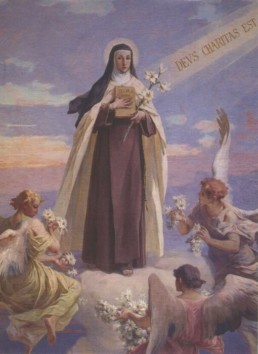
Chronology
| 1747 | 15 July – Birth of the Saint. |
| 1747 | 16 July – Baptism. |
| 1754 | First Confession at age of seven. |
| 1756 | 23 November – enters boarding school. |
| 1757 | 9 February – Confirmation at age nine. |
| 1757 | 15 August – First Holy Communion at age ten. |
| 1757 | Her father Ignatius becomes her spiritual director. |
| 1761 | Don Peter di Cosimo Pellegrini becomes her spiritual director. |
| 1763 | September – Anna Maria hears the words: “I am Teresa of Jesus, and I want you among my daughters.” |
| 1764 | 8 April – She returns home from boarding school. |
| 1764 | 15 July – Anna Maria’s seventeenth birthday, she tells her parents her desire to enter Carmel. |
| 1764 | 1 September – She arrives at the Carmel of Florence. |
| 1765 | 4 January – She completes her four months’ postulancy. |
| 1765 | 11 March – Her clothing. |
| 1766 | 12 March – Her Profession. |
| 1766 | 7 April – Taking of the veil. |
| 1767 | 28 June – She receives the grace of “Deus caritas est”. |
| 1767 | Fall? – Beginning of her Dark Night. |
| 1768 | Spring? – Father Ildefonse becomes her regular Confessor and Spiritual Director. |
| 1770 | 7 March – Death of the Saint. |
| 1770 | 31 March – Burial in the monastery crypt. |
| 1839 | Decree of Heroic virtues – Pope Gregory XVI. |
| 1929 | June 9 – Decree of beatification – Pope Pius XI. |
| 1934 | 19 March – Canonization – Pope Pius XI. |
St. Teresa of the Andes
St. Teresa of the Andes
ST. TERESA OF JESUS “OF THE ANDES” (Juana Fernandez Solar) was born in Santiago, Chile on July 13, 1900. Her parents were wealthy and had six children. Juana, the fourth, was affectionately called Juanita by her family and friends. Juanita did not start off as a saintly child. She worked hard to overcome her tendencies toward vanity and pride as a little girl. While she did possess an inclination to piety, she often manifested her fiery temperament. When she was ten, she made her First Communion. This event changed her completely. She recounted that it was truly “a fusion between my soul and God.” Each time she received Communion, she records that “Jesus spoke with me for a long time.”
Nevertheless, she was an ordinary teenager, who loved parties and dancing, excelled in horseback riding, tennis, croquet, and was an excellent swimmer. She had a lovely voice and a talent for music, playing the piano, and harmonium. She did very well in school but valued her membership as a Child of Mary over all her other accomplishments. Juanita was a beautiful young woman, and her diary reveals the struggles she had to grow in virtue. This intimate, personal account also records frequent bouts with bad health, and she realized that her life was to be one of suffering and love. She witnessed to the power of love and faith within her family circle and with friends, displaying a particular love and mercy towards her wayward brothers: one a proclaimed agnostic and the other who lived a bohemian lifestyle. Juanita was remembered as the bond of love that united her struggling family relations in the midst of difficult times.
She had a deep devotion to Our Lady and prayed the Rosary every day. At fourteen she made a vow of virginity and resolved to become a Carmelite nun. This decision may have been influenced by her reading of the autobiography of St. Therese of Lisieux, Story of a Soul. Like St. Therese, she strove for holiness wherever she found herself: at home, at school, with her young friends.
On May 7, 1919, she entered the Carmelite Monastery of Los Andes and was given the name Teresa of Jesus. Her joy was great in Carmel. She wrote: “It is impossible to imagine how happy I am. I feel peace and an intimate joy.” She saw everything that happened to her as coming from the hand of God and joyfully looked for opportunities to offer sacrifices to Him. Shortly after her entrance into Carmel, her health, which had always been precarious, began to fail. She became desperately ill with typhus and, in view of her impending death, was allowed to make her Solemn Profession. She died on April 12, 1920 at nineteen, having lived in Carmel a brief eleven months. She was beatified on April 3, 1987 and canonized by St. John Paul II on March 21, 1993. She is proposed as a model for young people and is the first Chilean and the first member of the Teresian Carmel in Latin America to be canonized. Her feast is celebrated on July 13.
More coming soon…
More coming soon…
St. Therese of Lisieux
St. Therese of Lisieux
ST. THERESE OF THE CHILD JESUS and THE HOLY FACE (Therese Martin), Doctor of the Church, was born in Alencon, France on January 2, 1873. The death of her Mother when she was three and a half deeply traumatized her and brought about an acute sensitivity and sadness which lasted for eight years. When she was ten, she began to experience a mysterious illness, which caused convulsions, hallucinations, and comas so severe that it was feared she would die. After three months, Therese was cured almost instantly by the Blessed Virgin, whose statue, Therese said, smiled at her at the moment of her cure. This experience of Mary’s maternal love flowered fully in Carmel. “How I love the Blessed Virgin,” she wrote. “She is described as unapproachable, whereas she should be pointed to as a model.” “I do not tremble when I see my weakness, for the treasures of a mother belong also to her child and I am thy child, O dear Mother Mary.” “Do not be afraid of loving the Blessed Virgin too much. You can never love her enough, and Jesus will be very happy because the Blessed Virgin is His Mother.”
From 1877 to 1886, she went through a spiritual trial of sensitivity and scruples. Healed of these at Christmas 1886, she began to attain psychological and spiritual maturity and developed a thirst to save souls and to pray for priests. Therese grew into a tall, blonde, blue-eyed girl. She was pretty, quiet, and somewhat reserved, but she could also be daring, vivacious, and entertaining.
Although she possessed a missionary heart, she realized she could be more effective in a cloistered life of prayer and sacrifice. On April 9, 1888, at fifteen, Therese entered the Carmel of Lisieux, where she spent the remaining nine and a half years of her life. Her appointment as Assistant Novice Mistress in 1893 gave her an opportunity to share her spiritual insights, particularly the “Little Way of Spiritual Childhood”—a rediscovery of the Fatherhood of God and the depths of His merciful love. Her memoirs, Story of a Soul, written under obedience, enshrine her teaching and her personal spiritual journey. Pope Benedict XV declared that it “contained the secret of sanctity for the entire world.”
After months of agonizing sufferings and temptations against faith, she died of tuberculosis on September 30, 1897, at the age of twenty-four. Therese was canonized in 1925 and named co-patron of the missions in 1927. St. John Paul II declared her a Doctor of the Church in 1997. Her feast day is observed on October 1.
The Little Way
What is the unique gift of St. Therese to the Church of today? St. Therese was indeed a spiritual genius. Formed as she was in a family atmosphere of faith and religious fervor, from childhood St. Therese’s one dream and ideal was that of holiness. But she faced one problem: when she looked at the lives of the saints, she saw herself as a mere “grain of sand” compared to mighty mountains!
“I have always wanted to be a saint. Alas! I have always noticed that when I compared myself to the saints, there is between them and me the same difference that exists between a mountain whose summit is lost in the clouds and the obscure grain of sand trampled underfoot by passers-by. Instead of becoming discouraged, I said to myself: God cannot inspire unrealizable desires.”
Therese sought to find a way, “a little way, a way that is very straight, very short, and totally new.” As she prayed for light, she came across a passage from Scripture with the answer: “As one whom a mother caresses, so will I comfort you; you shall be carried at the breasts and upon the knees they will caress you” (Is. 66:12-13). St. Therese’s Way was to be the path of Spiritual Childhood, the Little Way of Confidence and Love.
Merciful Love in a Jansenistic Age
It is surprising that in a religious environment and culture engrossed in Jansenistic thought–i.e. with the one-sided emphasis on God’s Justice and severity–that St. Therese had the discernment and light to pierce through these faulty conceptions. Although Jansenism was condemned as heresy by the Church in 1653, its effects were to impact the lives of Catholics for centuries to come.
For St. Therese, God was a loving Father whose compassion was infinite and who revealed Himself to her through His merciful love.
“It seems to me that if all creatures had received the same graces I received, God would be feared by none but would be loved to the point of folly; and through love, not through fear, no one would ever consent to cause him any pain… To me He has granted his infinite Mercy, and through it I contemplate and adore the other divine perfections! All of these perfections appear to be resplendent with love, even His Justice (and perhaps even more so than the others) seems to me clothed in love. What a sweet joy it is to think that God is Just, i.e., that He takes into account our weakness, that He is perfectly aware of our fragile nature. What should I fear then?”
It is amazing to read in these lines the spiritual insight of Therese and the undaunted trust she has in the merciful love of God. St. Therese extends this same message to us today: our God is a God of love and mercy; this love has the power to transform our lives!
Devotion to the Child Jesus & the Holy Face
St. Therese’s official name in religion was “Sr. Therese of the Child Jesus and of the Holy Face.” These two specific devotions played a vital role in her spiritual life.
Therese had an instinctive love for the Child Jesus which disclosed his littleness, humility and approachable presence. Devotion to the Child Jesus taught her to remain “little” and imitate his “childlike” simplicity.
Devotion to the Holy Face began around the time of her father’s illness. Therese contemplated in the Holy Face of Jesus the depths of His love that is stronger than death. Here, hidden in His Face, St. Therese found her rest, her “homeland”. In August of 1895, she composed a poem entitled “My Heaven on Earth”, which is a canticle to the Holy Face. Quoted below are a few striking lines from St. Therese’s pen:
“Jesus, your ineffable image
Is the star that guides my steps.
Ah! you know, your sweet Face
Is for me Heaven on earth…“Your Face is my only Homeland.
It is my Kingdom of love…“It’s my Rest, my Sweetness
And my melodious Lyre…“Your Face is my only wealth.
I ask for nothing more.
Hiding myself in it unceasingly,
I will resemble you, Jesus…”
Whether it be the Infant Christ or the Suffering Christ, St. Therese drew strength and inspiration from discovering hidden riches for her spiritual life.
Doctor of the Church
The Church has recognized 36 “Doctors of the Church” over the last two millennia. She reserves this distinction to saints who have made a significant contribution to the theology, doctrine or thought of the faith. St. Therese’s unique gift to the Church of all times was her radical Gospel simplicity and spiritual insight into the “Little Way” of holiness, open to all. She reminds us that sanctity consists in doing “little things with great love” and living the ordinary in an extraordinary way.
Why I love you, O Mary
Shortly before her death, St. Therese confided to her sister Celine: “There is one thing I have to do before I die. I have always dreamed of saying in a song to the Blessed Virgin everything I think about her.” A few months before her death she composed a poem to the Blessed Virgin entitled “Why I love you, O Mary.” With the love of a child for its mother, St. Therese expresses her admiration and love of the simple, hidden life of Mary revealed in the Gospels. In 25 stanzas, she sings of her love for Mary, who is more Mother than Queen in her own eyes. Here are a few sample verses that express her tender love of the Virgin:
“Oh! I would like to sing, Mary, why I love you,
Why your sweet name thrills my heart …” (Stz. 1)“The treasures of a mother belong to her child,
And I am your child, O my dearest Mother.
Aren’t your virtues and your love mine too?…” (Stz. 5)“While waiting for Heaven, O my dear Mother,
I want to live with you, to follow you each day.
Mother, contemplating you, I joyfully immerse myself,
Discovering in your heart abysses of love.
Your motherly gaze banishes all my fears…” (Stz. 18)
Have you ever wondered why St. Therese is always depicted as holding roses or rose petals? In the Last Conversations–a book containing the last sayings or conversations she had with Therese on her deathbed– Mother Agnes records these remarkable words of St. Therese on July 17, 1897:
“I feel that my mission is about to begin, my mission of making others love God as I love Him, my mission of teaching my little way to souls. If God answers my request, my heaven will be spent on earth up until the end of the world. Yes, I want to spend my heaven in doing good on earth.”
Earlier on June 9th, Sr. Marie of the Sacred Heart told Therese: “What sorrow we’ll experience when you leave us!” St. Therese responded:
“Oh, no, you will see; it will be like a shower of roses.”
And she added:
“After my death, you will go to the mail box, and you will find many consolations.”
She was right! After her death, mail began pouring into the Carmel of Lisieux testifying to the abundant graces obtained through Therese’s intercession. Some of these were from soldiers of World War I, who experienced Therese with them in the trenches, sparing them from imminent danger. These letters are still preserved today in the archives of the Carmel.
The shower of roses continues today…
St. Elizabeth of the Trinity
St. Elizabeth of the Trinity
ELIZABETH OF THE TRINITY(Elizabeth Catez) was born in 1880 in the military camp of Avor, near Bourges, France, where her father was an officer. Her early years belied her future as the calm, peaceful, and prayerful person she was to become. Her volatile temperament and outbursts of anger as a child were, as her younger sister Marguerite recalled, “terrible to behold.” Gradually, Elizabeth learned to control her anger. Gifted with a definite musical talent, at eight she was enrolled in the conservatory of Dijon, where she soon became one of its outstanding students and won many prizes for her piano playing. She developed into a warm, affectionate young woman who made friends easily, loved beautiful clothes and fancy hats, traveling, parties, dancing and hiking, and was highly sensitive to the beauties of nature and the arts while maintaining a fruitful apostolate of youth work, teaching catechism and visiting the sick and elderly.
At fourteen, she consecrated herself to God and placed herself and her future in the hands of the Blessed Virgin. Her confessor, the Dominican Father Valle, began to instruct her on the doctrine of the indwelling of the Holy Trinity in the soul. For Elizabeth, this was the revelation that was to characterize her entire spiritual life. A few days after her 21st birthday, she entered the Carmel of Dijon, where she became an exemplary religious. Elizabeth has been called a prophet of the presence of God dwelling in our souls.
Elizabeth lived only five years in Carmel. She died of Addison’s Disease at 26 on November 9, 1906. Pope Francis canonized her on October 16, 2016. The Order celebrates her feast on November 8.
The spiritual legacy of St. Elizabeth of the Trinity is rich and timely. In today’s culture which is surrounded with noise, St. Elizabeth’s witness promotes silence, recollection and adoration. The foundation of her spiritual life rests on the graces of Baptism and the indwelling of the Trinity. To be a “house of God”, a dwelling for God, was the ambient in which St. Elizabeth lived her life of contemplative prayer. She proposes this to all the baptized as a wellspring of prayer and holiness.
St. Elizabeth of the Trinity had a remarkable gift for music. At an early age her mother enrolled her at the conservatory of Dijon where she studied piano assiduously. Elizabeth was passionate about music and spent 5 hours every day at the piano, practicing. Her natural talent, coupled with her dedication won astonishing accomplishments for the young teenager. She was something of a child prodigy, with a promising career as a pianist ahead of her. But Elizabeth’s heart lie somewhere else.
From the day of her First Communion, Jesus had “stolen” her heart. She knew that she was to give herself to Him forever. Although she was prevented from entering the Carmel of Dijon until she was 21, her decision was unshaken.
Music was to play an important role in her spiritual life, as well. One unique quality tat it formed in her was a capacity for interior listening. St. Elizabeth described her soul as a lyre upon which the Holy Spirit would produce divine harmonies. Despite her great love for the piano and for music, Elizabeth was able to leave this all behind for a greater love, for the Divine Spouse who was calling her to live in the silent music of love and hidden prayer for the Church.
Listen below to some of Elizabeth’s favorite pieces, which she performed:
Chopin: Ballada En Sol Mineur N°1, Op.23
Demiér: Le Chant Du Nautonier
St. Elizabeth has been called a prophet of the presence of God dwelling in our souls. She found the perfect model of how to respond to this Presence in Mary. “The Virgin kept all these things in her heart. Her whole history can be summed up in these few words. It was within her heart that she lived.” Elizabeth loved to call Mary Gate of Heaven, because she saw Mary as standing at the threshold of her soul, opening a way into this mysterious Divine Presence. Imitating Mary, she became a faithful adorer in spirit and in truth of the Trinity dwelling in her soul.
Our Holy Father, St. John of the Cross
St. John of the Cross, Our Holy Father
ST. JOHN OF THE CROSS (Juan de Yepes), Priest and Doctor of the Church, is a key figure in St. Teresa’s reform of the Carmelite Order. His writings hold a unique place in the Church’s history of mystical theology and in the literary heritage of Spain. Within this quiet, unassuming man, austere yet gentle, reflective yet outgoing and friendly, burned the relentless flames of total commitment and profound mystical experience. John was born in the village of Fontiveros, Spain, some twenty-five miles from Avila, in 1542.
At twenty-one, he entered the Carmelite Monastery in Medina del Campo, where he obtained permission to follow the Carmelite Rule more strictly. Soon after his ordination to the priesthood, he met St. Teresa. He was 25 and she 52. Immediately enthused with him, Teresa wrote: “Although he is small in stature (just about five feet), I believe he is great in the sight of God.” She persuaded him to begin, with several other friars, her reform within the Carmelite Order. In this, he suffered many trials and persecutions, including being imprisoned for eight months in Toledo by Carmelites who were opposed to the reform. It was in this prison that, despite terrible physical and spiritual sufferings, he composed the poems that were to be the basis for his future writings. John credited Our Lady’s help with his success in escaping from the prison.
In the following years he held a number of administrative offices and served as spiritual director for Carmelite nuns, friars, and lay people. His most important accomplishment, however, was the composition of his four major works: The Ascent of Mt. Carmel, The Dark Night of the Soul, The Spiritual Canticle, and The Living Flame of Love. All his writings are commentaries on his poems, which are ranked among the greatest in Spanish literature.
St. John died at Ubeda on December 14, 1591. He was canonized by Benedict XIII in 1725 and declared a Doctor of the Church, the Mystical Doctor, by Pope Pius XI in 1926. The Carmelite Order celebrates his feast on December 14.
St. John of the Cross is both our Spiritual Father and a Doctor of the Church. This means that his spiritual legacy reaches far beyond the horizons of Carmel and to the Universal Church. His spiritual teaching on prayer, the souls quest for union with God, is both magnificent mystically and theologically rich. Having the qualities of a trained theologian, an exceptional gift for poetry, song and teaching, this man of God was small in stature, but a giant in wisdom and grace. St. John of the Cross is most well known for his treatise on the Dark Night, but also has profound writings on the Spiritual Canticle and Living Flame of Love. His Ascent of Mt. Carmel is only setting the stage for the journey that is to come. Nada is only in favor of making space for the Todo (God)! Making space for a free heart to follow the path of divine love is the way St. John of the Cross opens before us.
“Talk to this Father, I beg you,…although he is small, I know that he is great in the eyes of God…” (St. Teresa, Letter 13)
After John’s ordination in 1567, he returned to Medina del Campo to sing his first Mass. At the same time, Saint Teresa was in the same city, making her second foundation of Discalced Nuns. She had also obtained permission from the General of the Order, Juan Bautista Rubeo (Rossi) to establish some monasteries for friars, provided she could find and purchase a house for them. The first to volunteer (although with some misgivings on Teresa’s part!) was the Carmelite prior in Medina, Antonio de Heredia. Teresa, however, kept looking for her “firm foundation stone,” and found it in the person of Fray Juan de Santo Matia. She learned of him through his classmate and arranged for him to visit the parlor: “And when I spoke with this young friar, he pleased me very much. …Telling him what I was attempting to do, I begged him to wait until the Lord would give us a monastery…He promised me he would remain as long as he wouldn’t have to wait long.” (Foundations 3:17)
A few months later, Saint Teresa found the house for her friars in a tiny village, Duruelo. The “house” she had been given was, more precisely, a run-down shack. Despite its condition, she was assured by Fray Antonio that “he would be willing to live not only there but in a pigsty. Fray John of the Cross was of the same mind.” (Foundations 13:4)
Teresa left Antonio to gather the furnishings and other items needed for their house. Meanwhile, she brought Fray John of the Cross with her on the foundation to Valladolid, in order to teach him about the Discalced way of life; “so that he would have a clear understanding of everything, whether it concerned mortification or the style of both our community life and the recreation we have together. …He was so good that I, at least, could have learned much more from him than he from me. Yet this is not what I did, but I taught him about the lifestyle of the Sisters.” (Foundations, 13:5)
At the beginning of October of 1568, John and an unnamed stonemason arrived in Duruelo to prepare the house. At the end of November, Antonio de Heredia and two other friars joined John, and on November 28, 1568, the first Mass was said in the “little stable of Bethlehem,” and the Discalced Carmelite friars had their official beginning.
While references to Mary are not prolific in the writings of St. John of the Cross, she is always the reference point in his description of the soul’s ascent to God and perfect union with Him. “Such was the glorious Virgin, Our Lady, who having been raised to this high estate (union with God) from the beginning . . . was always moved by the Holy Spirit” (Ascent III: 2:10).